
Key facts
- 84% of small businesses now use AI for content creation — the highest adoption rate of any business size, per survey research.
- 77% of small businesses using AI have no formal prompting strategy or system, adoption data shows.
- 58% of top Google results are AI-assisted but human-edited, while unedited AI content makes up less than 0.5% of top results.
- Google rewards content quality rather than production method, but warns that scaled generation without added value violates its spam policy.
- Parallel AI agents cut a 28-hour sequential content job to roughly 33 minutes with 50 agents, industry analysis found.
- A single-agent AI approach failed in production because prompt complexity became unmanageable, prompting a split into Curator, Creator, and Critic roles.
- Business owners producing marketing content with AI commonly save 8–12 hours per week, small-business data shows.
WANT RESULTS LIKE THIS?
Imagine a system doing all of this for your local business — every day, without you.
We build local businesses a custom website with a team of AI behind it: every lead captured and followed up, new content published monthly,customers finding you on Google — live in 7 days.
- 85+ pages at launch
- Every lead followed up, automatically
- Your whole business on one screen
The Problem: Small Businesses Use AI for Content — Without a System
Every small business owner has opened ChatGPT at least once and asked it to write a blog post. That's not a competitive edge anymore — it's the baseline. The real question is what happens after the copy gets pasted into the website.
The adoption numbers are startling. Survey research shows 84% of small businesses now use AI for content — the highest rate of any business size, ahead of midsize and enterprise companies. Among AI-using small businesses, marketing content creation is the number-one use case at 68%.
But here's the gap that matters. That same research found 77% of small businesses using AI have no formal prompting strategy or system — and only 23% have received any formal AI training at all. The output reflects it: inconsistent tone, drifting topics, and pages that read like nobody checked them.
This is the execution gap. The tools are cheap — a Claude Pro and ChatGPT Plus subscription costs roughly $40 a month, a fraction of agency pricing. What's missing is structure. A business owner who "just uses ChatGPT" gets a different result than a managed pipeline because they're missing everything that surrounds the writing:
- A research step that grounds every piece in the business's actual services and service areas
- A verification layer that checks claims and citations before anything publishes
- Consistent formatting, internal linking, and SEO structure applied the same way every time
- Quality gates that catch the drift before it reaches the live site
The search results make the cost of skipping those layers visible. Data on Google rankings shows that 58% of top results are AI-assisted but human-edited — while unedited AI content is nearly absent from top results, at less than half a percent. The production method isn't what separates winners from losers. The system around the writing is.
Google's own position backs this up: the search team has stated its focus is on the quality of content, rather than how content is produced — while warning that scaled generation aimed at gaming rankings violates spam policy.
That's why done-for-you systems like AI Business Sites exist. Not because owners can't type a prompt, but because a prompt without a pipeline produces exactly what the data predicts: content that's cheap to make and invisible where it counts.
Why 'One AI Writing Everything' Fails: The Case for Specialized Agents
Hand one AI a research assignment, a statistics hunt, a first draft, a fact-check, and an SEO formatting spec in a single prompt, and the output tends to be mediocre at every step. The reason is structural, not a tool problem: a single agent juggling every role produces prompts so complex that error attribution becomes nearly impossible and revisions turn unreliable.
That's exactly what one practitioner discovered while building a production content system. A single-agent approach failed because "prompt complexity became unmanageable" and the revision process was unreliable — so the fix was to split the work into three specialized roles: a Curator to find the material, a Creator to write it, and a Critic to quality-check everything before it goes live. The same hands-on experiment, documented in a production lessons writeup, also introduced bounded retries — a critic loop capped at roughly three attempts, with repeatedly rejected content escalated to human review rather than published anyway.
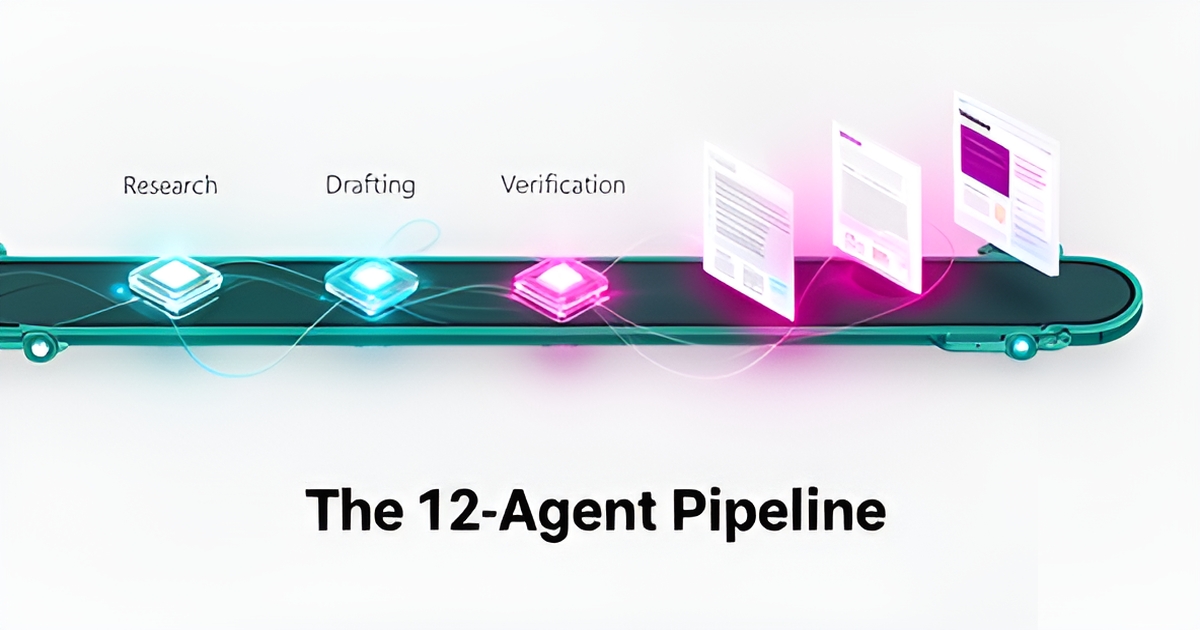
This is the difference between a chatbot writing a blog post and a production pipeline. In a pipeline, each step is a distinct specialist agent with its own prompt, its own quality criteria, and its own job. Industry analysis of multi-agent architectures describes hierarchical orchestration — a supervisor agent managing specialized sub-agents — as the pattern most useful for production-grade content systems. A typical content pipeline assigns roles like these:
- Research agent — gathers source material and background on the topic before any writing starts
- Statistics agent — finds real data points to anchor claims, so the draft isn't built on guesses
- Drafting agent — writes the piece against a defined brief: word counts, required elements, tone markers
- Verification agents — check every claim, confirm citations, and flag anything unsourced
- Formatting agents — add schema markup and structure the piece for search performance
The verification layer isn't optional polish — it's the ranking-safety mechanism. Google's official position is that it rewards quality rather than production method, but scaled content generated without added value violates spam policy. The data backs the editing requirement: 58% of top Google results are AI-assisted but human-edited, while unedited AI content is nearly absent from top results at under 0.5%.
The market context makes the pattern more urgent. 84% of small businesses now use AI for content, yet 77% of those businesses have no formal prompting strategy or system — which is why DIY single-agent output so often reads generic and inconsistent. That gap is the rationale for how AI Business Sites runs its content engine for Renovatly clients: 12 specialized agents covering research, statistics, drafting, claim verification, citations, schema markup, and SEO formatting, orchestrated as a supervised pipeline rather than one model generating text. Specialization is what turns AI content from a fast typist into a production system.
The Verification Layer: What Keeps AI Content Ranking-Safe
Here's the uncomfortable truth about AI content and Google rankings: unedited AI content is nearly absent from top search results — less than 0.5% of them. Yet AI-assisted content that gets human-edited makes up 58% of top-performing pages. The difference between those two outcomes isn't the AI. It's the verification layer wrapped around it.
Google's official position makes this clear. The search engine rewards quality, not production method — "using AI doesn't give content any special gains. It's just content." But there's a hard edge to that policy: generating many pages without added value can violate Google's spam policy on scaled content abuse. The warning shot came in early 2025, when an SE Ranking experiment tracked 20 websites built entirely with AI content. They ranked well at first — then lost all keyword rankings in February 2025.
This is why the verification layer matters more than the generation layer. At AI Business Sites, the content engine runs 12 specialized agents — research, drafting, statistics, claim verification, citations, schema markup, SEO formatting — and the verification agents are the ones that keep published pages safe. Every claim gets checked against sources. Every citation gets validated. Pages that can't pass the checks don't publish; they land in a human review queue.
The pattern is well-documented beyond any single platform. A practitioner who built a multi-agent pipeline found that a single-agent approach failed — prompt complexity became unmanageable and revisions were unreliable — so he split the work into Curator, Creator, and Critic agents, with a bounded retry loop capped at three attempts before escalating to human review. Industry analysis of parallel content systems reaches the same conclusion: quality control needs to be systematic, not manual, because generating content at scale is only useful if the outputs are actually good.
What a ranking-safe verification layer looks like in practice:
- Claim verification — every statistic and factual statement checked against a real source before it ships
- Citation checking — links and references validated, not invented
- Review gates — content scored against defined quality criteria, with low scores routed to human review
- Bounded retries with human fallback — rejected content gets a fixed number of fix attempts, then a person takes over
The stakes go beyond rankings, too. Roughly half of business audiences react negatively to detected AI content, so publishing unverified machine text risks brand trust as much as search visibility. The data on top-ranking pages tells the story plainly: AI can draft, but verified, human-reviewed content is what actually ranks.
Local business: doing this the old way?
One system replaces the whole pile.
All of it — the website, the follow-up, the content, the leads — built and run for you for $1,497 + $497/mo. Month-to-month, and you own everything.
See what your build includesWhat a Managed Pipeline Looks Like in Practice
Picture a contractor's website that never goes quiet: every week, keyword-targeted briefs flow into a content engine, and 14+ new pieces come out — blog posts, service and location pages, comparison guides — each one researched, verified, and linked into the site's existing structure. That's what a managed pipeline looks like when it's actually running.
The engine behind this kind of workflow isn't one AI writing a blog post. It's a production system: research agents, drafting agents, verification agents, and formatting agents, each doing one job. Practitioners who built single-agent systems found the approach collapsed under its own weight — "prompt complexity became unmanageable... error attribution was nearly impossible" — until they split the work across specialized roles with a critic agent checking every draft before it goes live.
Throughput is where the economics become tangible. Parallel agents cut a 28-hour sequential job to roughly 33 minutes when 50 agents run the same 10,000-piece workload, according to analysis of multi-agent content production. A single agent working sequentially is, as one analyst put it, "not a content pipeline — that's a very fast typist."
For a client like Renovatly, the weekly loop looks like this:
- Measure — rank tracking, traffic, and AI-citation monitoring feed the system
- Target — keyword research with real volume and difficulty data becomes briefs that steer the engine
- Edit and publish — automated internal linking connects every new page both directions, and AI-generated featured images ship with each piece
- Report — a weekly summary lands in the owner's inbox with what moved and what's next
The editing layer is what keeps this ranking-safe. Only about 58% of top Google results are AI-assisted but human-edited, while unedited AI content is nearly absent from top results, per survey research on AI content creation. Google's own position is that quality, not production method, determines rankings — but scaled content without added value violates spam policy. A pipeline with claim verification built in is the difference.
For the owner, the payoff is time. Business owners producing marketing content with AI commonly save 8–12 hours per week, according to small-business AI adoption data. A managed pipeline like the one AI Business Sites runs pushes that further: the owner never writes a brief, never crafts a prompt, never touches a publish button. The system researches, drafts, verifies, links, illustrates, and ships — and the owner reads a weekly report instead of a to-do list.
Your Next Step: Getting a Content Engine Working for Your Business
You already know your business needs consistent content. The research backs you up: 84% of small businesses now use AI for content creation, leading every other business size, yet 77% have no formal prompting strategy behind it. The tools are cheap. The discipline is what's missing.
So you have two honest paths. You can stack free and open-source AI tools yourself — the engines genuinely are free. But someone still has to build the car: host it, connect it to your website and CRM, keep it running, and teach it your business. That's a technical project, not a Tuesday. And as one practitioner documented after trying it, a single-agent approach falls apart fast — "prompt complexity became unmanageable... error attribution was nearly impossible" — which is why production systems split work across specialized agents with review gates.
The second path is a managed content engine. AI Business Sites runs the pipeline for you as part of one monthly system: research, drafting, claim verification, and publishing happen on schedule without you writing a word. The economics make the case — a documented DIY blog automation produces 10 posts a day for roughly $21 in tooling, but its own author admits "inconsistent blog length and occasional coherence issues." Raw automation without quality layers isn't a content strategy.
- Consistent output: 14+ keyword-targeted pieces every month, published whether or not you remember it exists
- Verification built in: 58% of top Google results are AI-assisted but human-edited, while unedited AI content is nearly absent from page one — the review layer is what keeps content ranking-safe
- Full ownership: every page, post, and piece of data belongs to you, month-to-month, cancel with 30 days' notice
The owners who win with content aren't the ones who write it. They're the ones whose system writes it while they're on a job site or with a customer. Free is only free if your time is.
If that describes your situation, book a free strategy call. It's 30 minutes, no obligation, and no sales pitch — just a real conversation about your business, your goals, and whether a managed content engine makes sense. You own everything the engine produces, from the first published page onward.
Frequently Asked Questions
Does Google penalize AI-generated content?
Can unedited AI content actually rank on Google?
Why can't I just use one AI like ChatGPT to write all my content?
How common is AI content creation among small businesses?
Is DIY AI content really risky if I skip fact-checking?
How much time does a managed AI content pipeline actually save?
The System Is the Strategy
The pattern running through this article is hard to miss: 84% of small businesses already use AI for content, but the winners aren't the ones with the best prompt — they're the ones with the best pipeline. Specialized agents for research, drafting, and verification beat a single chatbot every time, and the editing layer is what separates the 58% of top-ranking AI-assisted pages from the unedited content that never ranks. That's the gap AI Business Sites was built to close: a managed content engine with 12 specialized agents that researches, verifies, and publishes 14+ keyword-targeted pieces every month, so you never write a brief or touch a publish button. If you'd rather spend your hours on jobs and customers than on prompts, the next step is simple: book a free 30-minute strategy call. No obligation, no sales pitch — just an honest conversation about whether a managed content engine makes sense for your business. You own everything the engine produces, from the first page onward.
FOR local businesss — BUILT AND RUN BY US
Your website. Your content. Your leads. Your data.
$500 starts your build. Seven days later it's live — chat, booking, follow-up, and your Google presence all set up. Then we run it, every month. You do the work you actually get paid for.