
TL;DR
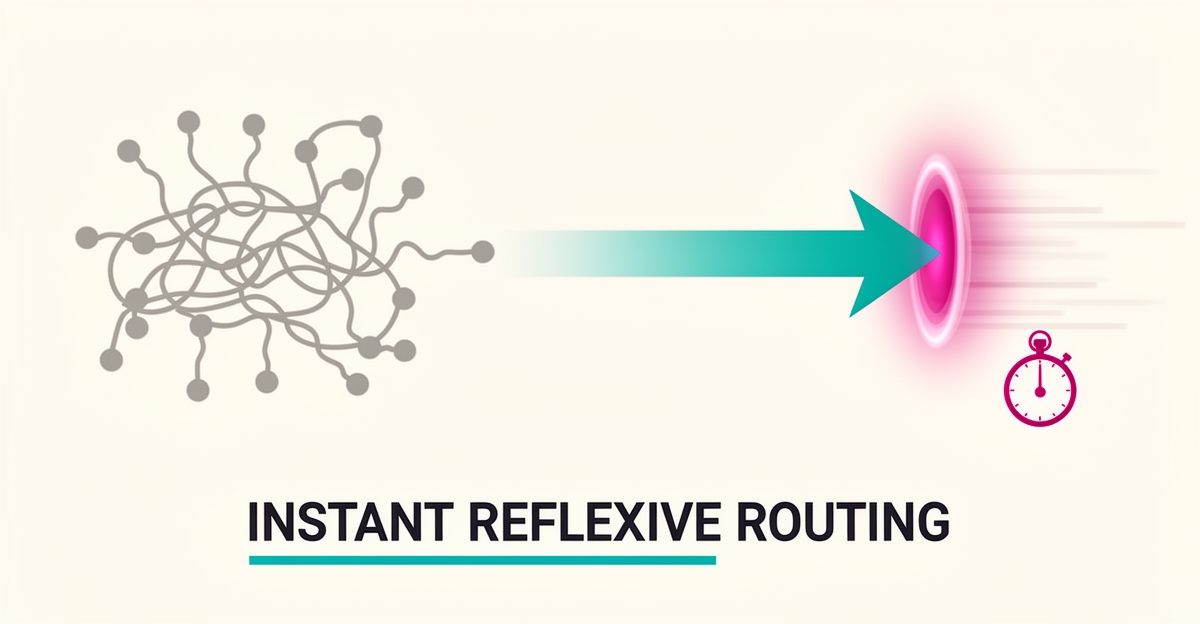
A new class of 'System One' AI models like Jev replaces slow, fragile LLM-based routing with instant, structured decisions — cutting latency from seconds to milliseconds and eliminating parsing failures in production automation.
Key points
- 01Generative LLMs (System 2) are architecturally mismatched for high-volume classification and routing tasks, introducing latency, parsing errors, and unpredictable costs.
- 02System One models like Jev output typed decisions (Choice, Score, Noul) with guaranteed schema adherence, calibrated probabilities, and sub-100ms latency via parallel sampling.
- 03Enterprise infrastructure (Databricks) is already integrating open-weight decision models via native SQL functions, signaling rapid production readiness for governed data pipelines.
- 04AI Business Sites can replace its LLM-based decision layer — lead triage, voice routing, automation guardrails, content QA — with decision models to protect margins and improve reliability.
- 05The shift mirrors Kahneman's dual-process theory: reserve expensive 'thinking' models for generation, deploy fast 'reflex' models for control-plane decisions.
You've built the AI agent. It answers chats, routes leads, triggers workflows, and summarizes tickets. In demo, it's impressive. In production, it's a liability. The agent thinks for three seconds, outputs JSON, your parser chokes on a missing bracket, and the customer hangs up. Or the invoice automation fires twice because the LLM 'decided' to run it again. Or your $497/month margin evaporates because every lead triage burns 2,000 tokens on GPT-4o-mini. The problem isn't your prompt engineering. It's the architecture. You're using a System 2 model — a deliberate, token-by-token reasoner — for System 1 work: instant classification, routing, and guardrails. A new class of foundation model is changing that calculus.
The Architecture Mismatch: Why LLMs Struggle at the Control Plane
Enter System One: Decision Models as a Distinct Workload
Enterprise Validation: Databricks and the SQL-Native Decision Layer
Mapping Decision Models to the AI Business OS
Economics, Ownership, and the Flat-Fee Promise
Risks, Guardrails, and the Hybrid Path Forward
Conclusion
The industry spent two years stuffing generative models into every slot — chat, code, classification, routing, guardrails. That era is ending. The emergence of System One decision models marks the specialization of the AI stack: fast, structured, calibrated reflexes for the control plane; slow, rich, creative reasoning for the generation plane. For AI Business Sites, this isn't a distant research topic. It's a concrete lever to make the 7-day build faster, the $497/month margin durable, the 'real AI, visibly working' promise measurable in milliseconds. The prototype starts this week. The architecture doc gets a new layer: Decision Layer (System One). And the next time a prospect asks why their AI agent feels slow, the answer won't be 'better prompts.' It'll be 'wrong model for the job.'