
NEWS.AR—AI Website Design & Marketing

From Website Builder to Business Operating System: How One Platform Shipped a Month That Changed the Small-Business AI Story

In thirty days, AI Business Sites shipped jobs and invoicing, native meetings with AI notes, a real estate module, a lead-relay engine, and an autonomous SEO team — transforming from a website builder into a full AI business operating system.

AI Website Design & MarketingOctober 7, 2026
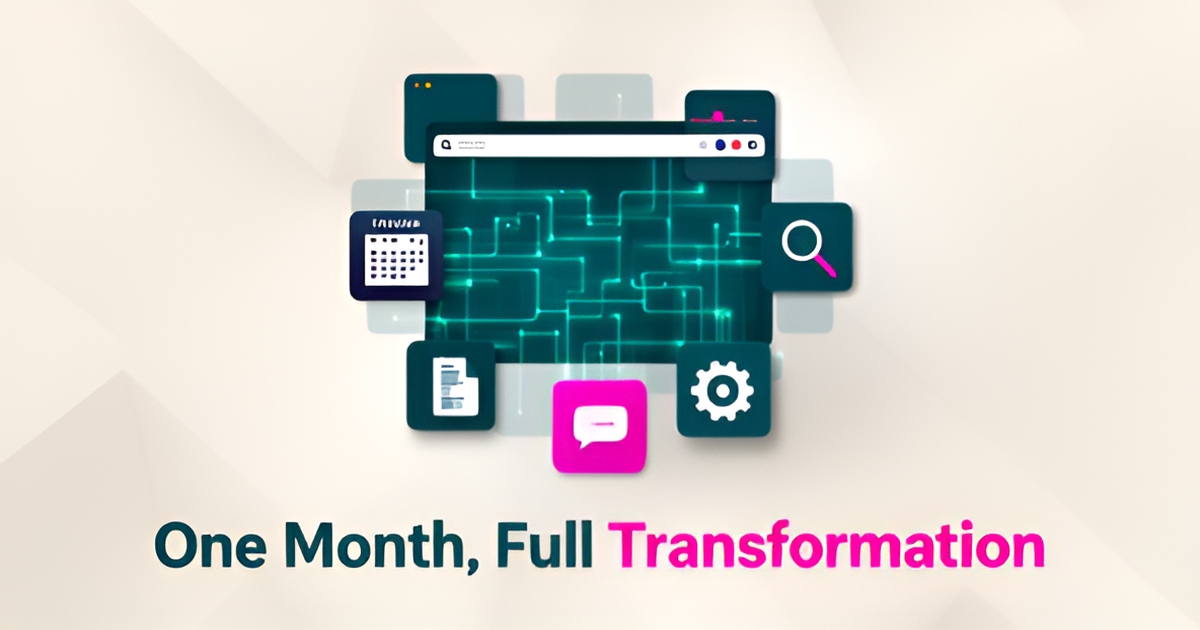
Flat illustration of a website evolving into a connected AI business operating system with teal and magenta module icons and a headline reading One Month, Full Transformation.

TL;DR

In a single month, AI Business Sites moved from building websites to running entire small businesses — jobs, invoicing, meetings, real estate, lead routing, and an autonomous SEO team — all included in one flat monthly price.

Key points

  • 01Between September 10 and September 28, 2026, the platform shipped a field-service module, native meetings with an AI notetaker, a real estate module, a lead-relay engine, a rebuilt social content factory, and an autonomous SEO team.
  • 02The Jobs & Estimates module closes the quote-to-review loop — AI drafts the quote from a call, the customer approves online, the invoice collects itself, and the review request follows payment.
  • 03The included SEO Growth Engine now tracks not just Google rankings but AI-citation share of voice across ChatGPT, Perplexity, Google AI Mode, and Gemini.
  • 04Everything remains one price: $1,497 setup plus $497/month, month-to-month, with clients owning all code, content, and data.
  • 05The platform's answer to per-seat software fatigue is a conversational interface: owners talk to the system instead of learning another dashboard.

Most software companies announce a roadmap and ship a fraction of it. In September 2026, AI Business Sites did the opposite: over roughly four weeks, the Halifax-based company — built by AIQ Labs — quietly delivered a field-service operations module, a native meetings-and-notetaking stack, a complete real estate module, a lead-routing and billing engine, a rebuilt social content factory, and an autonomous multi-agent SEO team. Individually, any one of those would be a product launch. Together, they signal something bigger: the company is no longer selling websites with AI bolted on. It is selling an operating system for running a small business.

A Month of Shipping, Not Announcing

The internal build log reads like a product roadmap compressed into thirty days. On September 10, the field-service module — quotes, job boards, calendars, and the technician's My Day view — was audited and confirmed live. Three days later, white-label public pages for quotes, invoices, and storefronts were complete. By September 14, jobs and e-commerce automation was wired end to end, with real triggers firing from quote approvals, paid invoices, and abandoned carts. The following week brought the meetings stack: native booking pages on the client's own domain, self-hosted video meeting rooms with unlimited minutes, and an AI notetaker that writes the summary, key points, and action items directly into the CRM record. Then came the real estate module (branded Realtix), the Relay lead-relay engine — audited with 38 of 38 tests passing — a full rebuild of the Social Content Factory covering 12 platforms and 34 content types, and finally, on September 28, live SMS sending for customer notifications and follow-ups. For small business owners, the significance isn't the shipping cadence itself. It's what the cadence produced: a platform where the website, the CRM, the quoting, the scheduling, the invoicing, the content, the SEO, and even the meeting notes now live in one system, managed by one team, for one price.

The Quote-to-Review Loop, Closed by AI

The flagship of the September blitz is the Jobs & Estimates module, and it targets a pain point every tradesperson knows: the gap between the phone call and the paid invoice. Here is how the loop runs. A customer calls; the AI answers and captures the details. From the transcript, the assistant drafts a line-item quote — services, materials, quantities, tax, and a valid-until date. The owner approves it from their phone. The customer opens a public page, sees good-better-best options that update the total live, types their name to sign, and approves in one tap. The moment they do, a job card lands on the calendar. From there, the technician's My Day view shows today's visits with big Start, On My Way, and Finish buttons — each tap sending the matching customer notification. The invoice goes out pre-filled with a public pay page and card payment through the business's own Stripe account, with automated day-3, day-7, and day-14 reminders. And after payment, the review request goes out. The whole loop is included in the $497 monthly fee — not a per-seat subscription, not a paid add-on. That last point matters. Field-service incumbents have built their businesses on per-seat pricing and add-on gates for reviews, e-signature, and pipelines. This module is a direct counter-argument: one flat price, everything included.

The New SEO Question: Who Does the AI Recommend?

Perhaps the most forward-looking piece of the September releases is the SEO Growth Engine — a multi-agent team that runs a weekly measure, target, edit, publish, and report loop, included in the monthly fee rather than sold separately. It does the expected work: rank tracking on Google and Bing, keyword research with real volume and difficulty data, content briefs that steer the platform's content engine, internal linking, and rewrites of decaying pages — every edit versioned and revertible. But it also does something most small-business owners have never heard of: it tracks AI-citation share of voice. When someone asks ChatGPT, Perplexity, Google AI Mode, or Gemini for a plumber, a landscaper, or a dentist, does the AI mention your business? How often, compared with your competitors? As search behaviour shifts from typed queries to conversational AI, that question is becoming as important as page-one rankings — and almost no small business has a way to measure it. Now, every client gets a weekly report that answers it, alongside rank movers, clean traffic numbers, and a plain-language plan for the week ahead. The engine publishes more than 14 new SEO-targeted content pieces every month, each with an AI-generated featured image, and it refuses to publish prices it can't verify: comparison pages pass through a deterministic fact-check layer and must score at least 85 out of 100 to go live automatically. Lower scores land in a human review queue with a machine-written audit attached.

Built for Owners Who Are Scared of Software

Underneath all of it is a design philosophy that separates this platform from competitors bolting AI onto existing software: the AI is the interface, and the dashboard is the fallback. The target customer — a contractor, a salon owner, a restaurant operator, a realtor — is typically not eager to learn another piece of software. Many already struggle with complex field-service tools. So every capability has a conversational entry point. Instead of navigating a quote builder, the owner types or says: "draft a quote for yesterday's call." Instead of opening a reports dashboard: "which invoices are unpaid?" The assistant can even fan out up to five parallel research workers — "research these five competitors" — while the owner watches the work happen live, lane by lane. The honest counter to the DIY argument is baked into the company's messaging: the underlying AI engines are free and open source, but someone still has to build the car — host it, connect it to the website, the calendar, the CRM, and keep it running. Free is only free if your time is.

One Price, No Lock-In

The pricing model has stayed deliberately simple through all of this growth: a $1,497 one-time setup — $500 deposit, $997 due at launch, so the client sees the work before paying the balance — and $497 per month, month-to-month, with 30 days' notice. The site goes live in seven days with 85 or more pages. Only four capabilities are sold separately: Lead Generation at $149/month, Outreach at $229/month, Social Content at $299/month, and the AI Receptionist — a dedicated phone number the AI answers 24/7 — at $199/month. Everything else, including the jobs module, the SEO team, the meetings stack, and online selling, is included. And the ownership story is unusual for the industry: the client owns the code, the content, the lead data, and the domain. Leave, and the complete website code goes to a GitHub repository in the client's name, with a full database export. As the company puts it: cancel with 30 days' notice, leave with everything — "we keep you by doing the work."

Conclusion

September 2026 may be remembered as the month the small-business website category changed shape. When a website can draft the quote, book the job, collect the payment, take the meeting notes, stage the listing, route the leads, and file a weekly SEO report — all while the owner runs the actual business — it has stopped being a website in any meaningful sense. It has become the back office. For owners tired of per-seat subscriptions and software they never have time to learn, the pitch is disarmingly simple: you talk to it, it does the work, and if you ever leave, everything you paid for goes with you. The next question for the industry isn't whether AI can run a small business's operations — it's who else can deliver that without handing the owner a technical project. If that describes your situation, the place to start is a demo.