
Key facts
- Visitors form a first impression in 50 milliseconds and 94% is design-related according to web design statistics.
- Around 90% of websites have implemented responsive design according to recent research.
- Nearly 93% of web designers now use AI tools in their workflows according to industry data.
- Mobile-friendly websites see 40% higher conversion rates according to web design statistics.
- Poor design and content drive away 38% of web visitors according to recent research.
- 53.8% of designers cite lack of responsive design as top redesign reason according to web design statistics.
- Original graphics drive 20% more engagement than stock photos according to industry data.
WANT RESULTS LIKE THIS?
Imagine a system doing all of this for your local business — every day, without you.
We build local businesses a custom website with a team of AI behind it: every lead captured and followed up, new content published monthly,customers finding you on Google — live in 7 days.
- 85+ pages at launch
- Every lead followed up, automatically
- Your whole business on one screen
The 50-Millisecond Verdict: Why Design Type Determines Business Success
Visitors form a first impression of your website in just 50 milliseconds, and 94% of those impressions are design-related. Within that split second, visitors decide whether to stay or leave—making design not just an aesthetic choice but a critical business decision. A poorly designed site drives away 38% of potential customers, while slow loading times cause 60% of visitors to abandon a page that takes over two seconds to load.
The stakes are especially high for mobile users. Over 60% of website visits now come from mobile devices, and 57% of users are less likely to recommend a business with a poor mobile experience. Meanwhile, mobile-friendly websites see 40% higher conversion rates, and responsive design—used by approximately 90% of websites—achieves 11% higher conversion rates and 15% more mobile engagement. These metrics show that design directly impacts revenue, trust, and customer retention.
AI Business Sites applies AI across design methodologies to ensure every element serves a purpose. The platform uses a 12-specialized-agent content engine to generate research-backed, SEO-optimized pages with AI-generated featured images that align with brand style. For responsive and mobile-first design, it implements tap-to-call features and swipe galleries as standard. For expressive approaches like maximalism or brutalism, it creates immersive experiences using parallax scrolling and animated storytelling. Every design choice is grounded in data, from fact-checked comparison pages to conversion-optimized calls-to-action that boost visitor conversion by 42% compared to generic ones. This isn’t about following trends—it’s about building a website that works as hard as the business behind it.
From Purposeful Simplicity to Bold Expression: The 5 Core Design Methodologies
From Purposeful Simplicity to Bold Expression: The 5 Core Design Methodologies
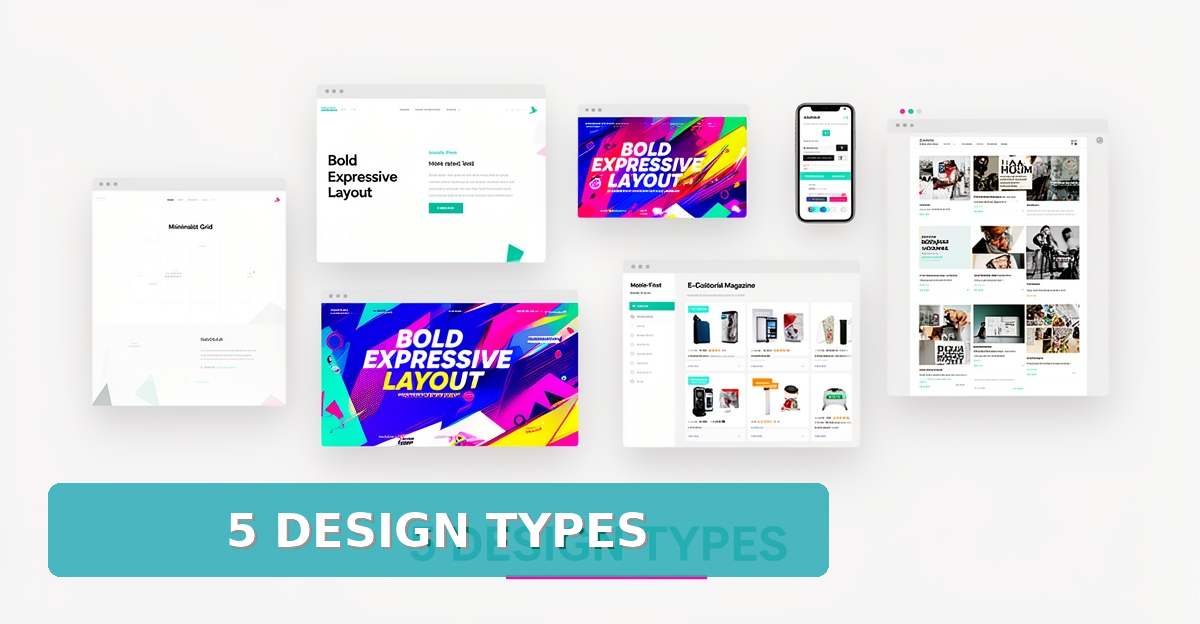
Modern website design has evolved into distinct methodologies, each serving specific business goals while adapting to how users actually interact with sites today. With over 60% of website visits originating from mobile devices, design choices directly impact engagement and conversion rates.
Purposeful minimalism focuses on functionality where every element serves a clear role, eliminating decorative clutter to guide users toward key actions. This approach aligns with the finding that 73% of companies prioritize design for brand differentiation, ensuring visual choices support business objectives rather than merely following trends. Bold minimalism builds on this foundation by incorporating strategic vibrant accents—like electric blue or neon green—within clean layouts to add personality without sacrificing professionalism.
Maximalism embraces layered graphics, clashing colors, and oversized headlines to create emotional impact and memorable brand experiences, while brutalism uses intentional asymmetry and restricted palettes to convey authenticity and nonconformity. Both approaches benefit from AI-generated featured images that maintain visual consistency across complex designs, with original graphics driving 20% more engagement than stock photos.
Mobile-first responsive design remains essential, as websites with responsive design achieve 11% higher conversion rates and mobile-friendly sites see 40% higher conversion rates. AI Business Sites applies these methodologies through its 12-specialized-agent content engine, which generates 14+ new SEO pieces monthly while implementing responsive principles, tap-to-call features, and swipe galleries as standard requirements for the majority of traffic coming from mobile devices. Each approach serves different goals: purposeful minimalism for clarity and trust, bold minimalism for approachable professionalism, maximalism for emotional engagement, brutalism for authentic differentiation, and mobile-first responsive design for accessibility and conversion optimization across devices.
The Mobile-First Reality: Why Responsive Design Is No Longer Optional
More than 60% of website visits now come from mobile devices, and Google ranks sites based on how well they work on a phone. That single shift has turned responsive design from a nice-to-have into the foundation every other design decision sits on. Ignore it, and everything else you build is compromised.
The adoption numbers tell the story. Roughly 90% of websites have now implemented responsive design, and the payoff is measurable: sites with responsive layouts achieve 11% higher conversion rates, and mobile users engage 15% more with them. Mobile-friendly websites also see 40% higher conversion rates overall, which explains why more than half of businesses report sales growth after going responsive.
So what does "doing mobile right" actually require in practice? Beyond a layout that flexes to any screen size, current standards call for features built around how people use phones:
- Tap-to-call buttons so a visitor can reach you in one touch
- Swipe galleries instead of click-based image carousels
- Load times under two seconds — sites that take longer potentially lose 60% of their visitors
- Easy-to-dismiss pop-ups, since pop-ups that frustrate mobile visitors annoy 70% of them
Speed deserves special emphasis because the cost of failure is steep. 88.5% of users cite slow loading as a top reason to abandon a mobile site, and a one-second delay can cut conversions by 7%. Slow image loading alone causes 39% of users to lose interest. On mobile, performance isn't a technical metric — it's a revenue metric.
The reputational damage compounds, too. If a site doesn't work well on mobile, 57% of users are less likely to recommend it, and businesses that neglect their mobile experience risk leaving a negative impression on 84% of users. Poor mobile design doesn't just cost you a visit — it costs you the word-of-mouth that brings the next ten.
Here's the number that should make any business owner pause: 53.8% of designers cite lack of responsive design as the top reason for a website redesign. In other words, more than half of all redesigns exist because someone skipped this foundation the first time. Building mobile-first from day one is cheaper than rebuilding later.
This is also where AI has changed the game. Nearly 93% of web designers now use AI tools in their workflows, and AI-powered design tools give small businesses access to on-trend, mobile-optimized visuals without expensive agencies. At AI Business Sites, every build starts mobile-first with responsive design, tap-to-call features, and fast load times baked in — and the AI content engine keeps every new page it publishes consistent with those standards, month after month.
Over 84% of visitors prefer mobile websites over desktop versions, and mobile-friendly design increases repeat visits by 75%. Meet your customers where they are — on their phones — or watch them find a competitor who does.
Local business: doing this the old way?
One system replaces the whole pile.
All of it — the website, the follow-up, the content, the leads — built and run for you for $1,497 + $497/mo. Month-to-month, and you own everything.
See what your build includesThe AI Advantage: How 93% of Designers Are Optimizing Every Design Type
AI is reshaping how websites are designed, with nearly 93% of web designers now using AI tools to enhance their workflow. This widespread adoption means AI isn’t just a futuristic add-on—it’s becoming central to how modern websites are built, optimized, and maintained. For small businesses, this shift makes professional-grade design accessible without the traditional agency costs of $30 to $200 per hour.
AI Business Sites leverages this trend by applying AI across every design methodology through its 12-specialized-agent content engine. Designers report that 58% use AI for imagery, 51% for page layouts, and 49% for experimenting with new design strategies—capabilities the platform integrates directly into its workflow. For example, AI-generated featured images on every page drive 20% more engagement than stock photos, while personalized CTAs boost conversion by 42% compared to generic alternatives.
The platform also uses AI to create fact-checked comparison pages, a sixth content type validated through a mandatory verification layer that ensures every claim is grounded in sourced data. This approach supports maximalist and brutalist design preferences by combining bold visuals with trustworthy, detailed content. Meanwhile, mobile-first principles are embedded in all designs, recognizing that over 60% of website visits come from mobile devices and mobile-friendly sites see 40% higher conversion rates.
By automating research, drafting, verification, and publishing, AI Business Sites turns complex design execution into a streamlined, managed process. The result is a website that doesn’t just look professional—it performs like a business system, adapting to each design type while keeping control in the hands of the business owner.
Implementation Roadmap: Choosing and Executing Your Design Approach
Implementation Roadmap: Choosing and Executing Your Design Approach
Matching your website design to business goals starts with understanding what each approach delivers. Minimalist design works best for professional services where clarity and trust matter most, while bold approaches with strategic color accents help creative businesses stand out in crowded markets. For local service businesses, mobile-first design isn't optional—over 60% of website visits come from mobile devices, making responsive layouts essential for capturing nearby customers searching on their phones.
The DIY versus done-for-you reality shapes your timeline and budget. AI website builders at $12-$42 per month require your time to learn the platform, build pages, and maintain content—turning what seems like a low cost into a significant time investment. Custom design ranging from $500 to $10,000 delivers unique results but demands upfront capital and ongoing developer reliance for updates. AI Business Sites offers a middle path: done-for-you implementation that launches 85+ pages in 7 days with responsive design, AI-generated imagery, and ongoing optimization included in the $497 monthly management fee.
This approach eliminates the learning curve of DIY builders while avoiding the large initial outlay of custom agencies. You get a mobile-optimized site built on Next.js and React, complete with schema markup and tap-to-call features that align with how over 84% of visitors prefer mobile experiences. The system handles technical maintenance so you focus on serving customers, not managing plugins or updating code. For businesses ready to move beyond brochure websites toward actual lead-generation systems, this implementation roadmap turns design strategy into live results without requiring technical expertise or sacrificing ownership of your digital assets.
Frequently Asked Questions
What are the main types of website design methodologies mentioned in the research?
How does responsive design impact conversion rates according to the research?
Why is mobile-first design considered essential for modern websites?
How does AI improve website design and content according to the research?
What percentage of web designers use AI tools in their workflow, and for what purposes?
What are the risks of ignoring mobile optimization for a business website?
Design That Works As Hard As You Do
From purposeful minimalism to bold expression, the right website design methodology isn’t about trends — it’s about matching how people actually find and use your site today. With over 60% of visits coming from mobile and 94% of first impressions formed in 50 milliseconds, mobile-first responsive design, clarity, and speed are business decisions, not aesthetic ones. AI is now part of that equation, with nearly 93% of designers using AI tools to generate imagery, layouts, and performance improvements. The opportunity is to choose a design approach that serves your specific goal — trust and clarity for professional services, emotional impact for creative brands, or conversion-first mobile accessibility for local businesses — and execute it with consistency. If you’re weighing DIY builders against custom agencies, consider a done-for-you path that launches 85+ pages in 7 days with responsive design, AI-generated imagery, and ongoing content included. Book a free strategy call to map the right design methodology to your business goals without obligation.
FOR local businesss — BUILT AND RUN BY US
Your website. Your content. Your leads. Your data.
$500 starts your build. Seven days later it's live — chat, booking, follow-up, and your Google presence all set up. Then we run it, every month. You do the work you actually get paid for.