
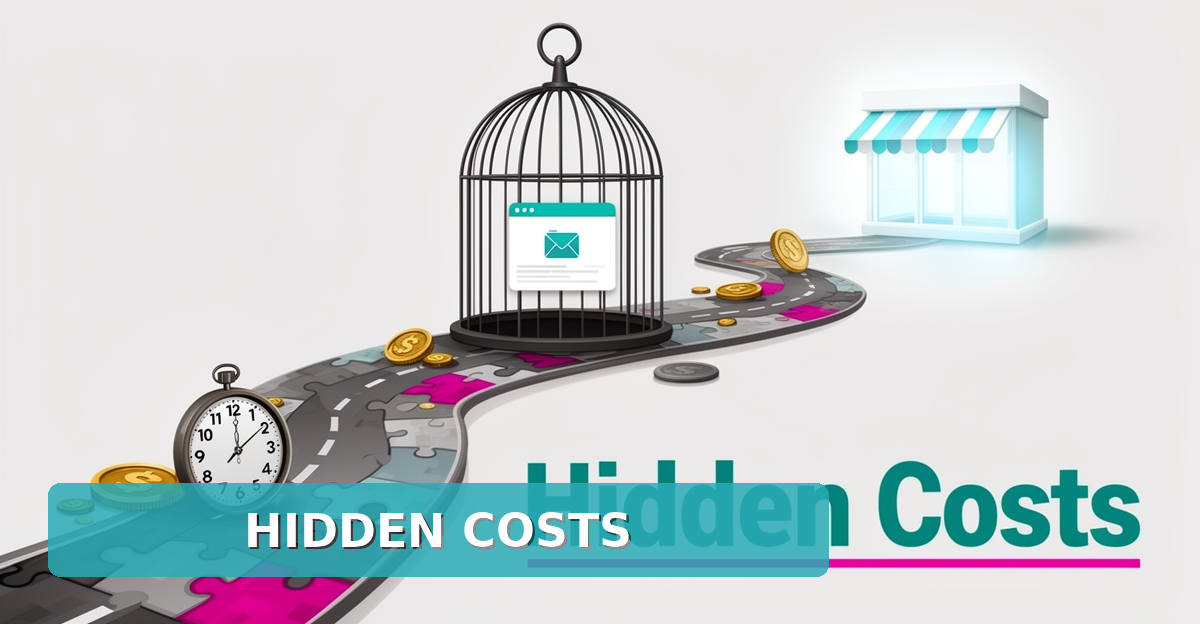
Key facts
- 45,381,200 users use Wix and growing according to Yoko Co
- Squarespace has millions of launched websites since 2004 per Yoko Co
- Custom domain hosting adds $8-$30 per month to website builder plans noted by Yoko Co
- Free website builder tiers display platform advertisement logos unless upgraded per Yoko Co analysis
- Web development beginners spend significant hours figuring out technical setup per Yoko Co
- Using template builders is comparable to renting instead of owning your website explains Chris Yoko
- E-commerce and CRM integration typically require paid add-ons on website builders noted by Yoko Co
WANT RESULTS LIKE THIS?
Imagine a system doing all of this for your local business — every day, without you.
We build local businesses a custom website with a team of AI behind it: every lead captured and followed up, new content published monthly,customers finding you on Google — live in 7 days.
- 85+ pages at launch
- Every lead followed up, automatically
- Your whole business on one screen
The DIY Website Builder Trap: Why 'Easy' Comes with Hidden Costs
The marketing promises drag-and-drop simplicity, but the launch reality for most small business owners is a different story. DIY builders sell speed, yet the setup, learning, and maintenance burden lands squarely on you.
The gap between promise and reality shows up first in the technical load. Even with 24/7 support, web development newbies end up spending a lot of time trying to figure everything out during launch according to Yoko Co. Domain linking, host configuration, and template population are not one-click tasks. Users describe the DIY experience as a rough road characterized by stress, struggle, and tech-rage as framed by Big Cat Creative.
Hidden costs compound the frustration. Even those that offer free hosting require an additional monthly cost of $8-$30 per month if you'd like to link the site to a custom domain with a different registrar notes Yoko Co. Free tiers carry visible platform advertisement logos unless upgraded per the same analysis, and essential functionality like e-commerce and CRM integration typically sits behind paid add-ons.
Ownership constraints create longer-term risk. Using template website builders is comparable to renting instead of owning your website explains Chris Yoko. You own content like furniture in an apartment, but you wouldn't be able to take the web design with you should you decide to host with someone else. Should there be any violation of the agreement, the website builder would legally be able to take your website down at their discretion he adds.
The learning curve is real, even on popular platforms. Wix now serves 45,381,200 users and growing per Yoko Co, and Squarespace has millions of launched websites since its inception in 2004 according to the same source. Scale does not equal simplicity. Squarespace itself acknowledges boundaries, stating that while no coding knowledge is required for basic sites, knowing code can help with building more complex websites on its own site.
Customer testimonials reflect the stress point. One owner said before the template I felt completely stuck and unsure how to best showcase my work and offerings to future clients shared by Big Cat Creative. Another noted that unlike past DIY attempts, I feel like I will actually be able to maintain this website in a testimonial, highlighting maintenance confidence as a stated gap.
The DIY trap is not a lack of tools. It is the time tax.
- Domain and hosting setup is manual and error-prone
- Template population and design tweaks consume hours of trial and error
- Ongoing content, SEO, and technical maintenance remain the owner's job
That is why the done-for-you model matters. AI Business Sites builds and runs the entire AI-powered business presence, so owners skip the rough road of figuring out complex systems during launch. With custom build and full setup and support, the website becomes a system that answers, writes, sells, and remembers instead of a brochure you have to maintain.
You Don't Own Your Website: The Renting vs. Owning Problem
Here's a question most business owners never think to ask until it's too late: if you canceled your website builder subscription tomorrow, would your website actually come with you?
For most DIY platforms, the answer is no. Chris Yoko of web design agency Yoko Co puts it plainly: using template website builders is comparable to renting instead of owning your website. You still own your content the way you'd own furniture in an apartment — but like the apartment building itself, you can't take the web design with you if you decide to host somewhere else.
That distinction matters more than it first appears. Your pages, images, and copy might be exportable, but the design, structure, and functionality live inside a closed-source platform you can't move. Rebuild on another platform and you're often starting from scratch.
The renting arrangement carries other risks, too. Yoko Co notes that under a platform's terms of service, the builder could legally take your website down at its discretion if it believes you've violated the agreement — like an eviction. It's rare, but it's a level of control over your business's front door that you don't hold.
There's also the question of what "ownership" even costs. Even platforms offering free hosting typically charge an additional $8–$30 per month if you want to link your site to a custom domain from a different registrar. And free tiers often display the platform's advertisement logos on your site until you upgrade.
So what does true ownership look like? A few things worth checking before you commit to any platform:
- The code — the actual site files, in a standard technology any developer can work with, not a proprietary format locked to one vendor.
- The domain — registered in your name, not the platform's, so your web address travels with you.
- The content — every page, image, and document, exportable in full if you leave.
- The data — your leads, customer records, and analytics, not held hostage inside someone else's dashboard.
This is the reasoning behind how AI Business Sites structures its service: clients own the code, content, data, and domain outright, and if they ever leave, the complete website code is pushed to a GitHub repository in their name along with a full database export. The site is built on React and Next.js — standard open-source technology any developer can pick up. There's no long-term contract, either; it's month-to-month with 30 days' notice.
The philosophy is simple: a service provider should keep your business by doing the work, not by holding your website hostage. When you're evaluating any website solution — builder, template, or custom build — ask the ownership question first. The answer tells you whether you're building an asset or paying rent on one.
The Hidden Costs Beyond the Monthly Fee
That $16-per-month starter plan looks like a bargain until you start adding the features your business actually needs to function. The advertised price rarely covers the full cost of a professional online presence.
Take custom domains, for instance. Even platforms advertising free hosting charge an additional $8 to $30 per month if you want to connect your own domain name rather than using their branded subdomain. Skip this fee, and your site displays the platform's advertisement logos—a digital "brought to you by" banner that undermines your professional credibility.
Then come the operational essentials. Need e-commerce functionality to process payments? That requires a premium tier. Want CRM integration to manage customer relationships? Add another subscription. Before long, you are juggling multiple paid add-ons just to achieve basic business functionality that should have been included from the start.
The real expense, however, is your time. Even with 24/7 support, web development beginners spend significant hours figuring out technical configuration, domain linking, and design customization. Those hours carry an opportunity cost—every evening spent troubleshooting templates is time not spent serving customers or growing revenue.
The true cost of DIY builders typically includes:
- Platform subscription fees that escalate with essential features
- Custom domain hosting charges ($8-$30 monthly)
- Premium add-ons for e-commerce, CRM, and advanced integrations
- The opportunity cost of your time spent on setup and maintenance
This is where the DIY math breaks down. While you piecemeal together solutions and manage technical details, you are essentially paying to work a second job as a web administrator. AI Business Sites eliminates these hidden costs by delivering a fully managed custom website with hosting, content generation, and business systems included—no surprise add-ons, no technical homework, and no late nights debugging templates.
Local business: doing this the old way?
One system replaces the whole pile.
All of it — the website, the follow-up, the content, the leads — built and run for you for $1,497 + $497/mo. Month-to-month, and you own everything.
See what your build includesA Brochure, Not a Business System: When Your Website Should Work For You
A website that looks fine on launch day can quietly become a liability the moment it needs to work. DIY builders sell speed and simplicity, but the finished product is usually a static brochure that stops at the visitor’s first click.
The research shows users are drawn to the low entry cost. Wix alone reports 45,381,200 users and growing, and Squarespace notes millions of launched websites since its inception in 2004. Scale creates the illusion of completeness.
In practice, the builder owns the relationship. Using template website builders is comparable to renting instead of owning your website. You keep content like furniture in an apartment, but you cannot take the design with you. Even with 24/7 support, a lot of web development newbies end up spending a lot of time trying to figure everything out.
Hidden costs accumulate fast. Even those that offer 'free' hosting require an additional monthly cost of $8-$30 per month if you'd like to link the site to a custom domain. Free tiers show visible platform advertisement logos unless upgraded, and essential functions like e-commerce or CRM integration sit behind paid add-ons.
The functional ceiling is the real constraint. Squarespace itself admits knowing code can help with building more complex websites, which quietly acknowledges the skill ceiling for custom functionality. Builders are fine for publishing, not for operating.
That is why DIY sites become brochures instead of business systems. Owners end up managing:
- Lead capture with no automatic follow-up or CRM routing
- Content creation and publishing on their own schedule
- Bookings, quotes, and payments stitched from separate tools
- Ongoing maintenance, updates, and troubleshooting
Customer testimonials echo the gap. One owner told Big Cat Creative they felt completely stuck and unsure how to best showcase their work before switching. Another noted they finally felt confident they could maintain the site because editing was simple and supported.
A done-for-you custom AI site flips the model. The website runs parts of the business instead of sitting there. AI Business Sites builds a custom site, sets up Google presence, and runs an AI back office with chatbot, CRM, content engine, and automations, so lead capture, follow-up, content generation, and customer communication happen without manual upkeep.
Ownership also changes. Clients own code, content, data, and domain, and can leave with everything. The system is managed month-to-month, so the owner runs the business while the platform handles the busywork that DIY builders leave on their plate.
The Done-For-You Alternative: Custom AI Sites That You Own
DIY website builders promise speed, but the launch process often turns into a rough road of stress and tech-rage. Owners spend hours figuring out setup instead of running their business, and the site they finally publish is a brochure, not a system.
The ownership model is the first trap. As one agency notes, using template builders is comparable to renting instead of owning your website. You own the content but not the design portability, and the builder can take the site down for a terms violation. That risk is rare, but it is real when you do not control the code.
Hidden costs accumulate quickly. Even “free” hosting requires an additional monthly cost of $8-$30 per month if you’d like to link the site to a custom domain with a different registrar. Free tiers also show visible platform advertisement logos unless upgraded. Those add-ons for e-commerce, CRM, and SEO turn a low entry price into a long-term subscription stack.
The learning curve is persistent. Even with 24/7 support that is offered with some of these resources, a lot of web development newbies end up spending a lot of time trying to figure everything out. Squarespace itself admits the ceiling: it’s not necessary to understand coding language to create a website, while knowing code can help with building more complex websites. In practice, complex functionality exceeds DIY capabilities.
Maintenance confidence is the unspoken gap. Customers describe past DIY attempts where they felt completely stuck and unsure how to best showcase their work and offerings to future clients. Another owner says they now feel like they will actually be able to maintain this website because they can quickly watch a video tutorial for a refresh. The burden stays with the owner.
The Done-For-You Alternative: Custom AI Sites That You Own removes those limits by building and running the business presence for you. AI Business Sites delivers a custom website plus an AI back office done for you, live in 7 days, and you own everything. The model is one setup fee and one monthly fee, managed entirely by us.
What changes with a done-for-you custom AI site:
- Full ownership of code, content, data, domain, and media with month-to-month exit and a complete export
- 85+ pages at launch with 14+ new SEO pieces per month, so content creation is handled not postponed
- Built-in CRM, chatbot, voice, automations, jobs and estimates, and online selling, replacing a stack of separate subscriptions
- Ongoing management by our team instead of owner-managed maintenance and troubleshooting
With DIY builders, Wix serves 45,381,200 users and growing and Squarespace reports millions of launched websites since its inception in 2004. Scale proves accessibility, but it does not erase the time burden, hidden fees, and portability constraints that owners face after launch.
A custom AI site is not software to learn. It is an operating system that answers, writes, sells, follows up, and remembers, with transparent pricing and assets you can take with you.
Frequently Asked Questions
Are DIY website builders really as easy as they claim?
What are the hidden costs of 'free' website builders?
Do I actually own my website if I build it with Wix or Squarespace?
Can website builders handle complex or custom functionality?
How much of my time will a DIY website really take?
What's the alternative if I don't want to build and maintain a website myself?
Stop Renting Your Online Presence
DIY builders sell speed but deliver a time tax: manual domain and hosting setup, hours of template tweaks, and ongoing maintenance that stays on your plate. The hidden costs add up fast with custom domain fees, paid add-ons for e-commerce and CRM, and free tiers that show platform ads. More importantly, you don’t own the system you’re building on — it’s renting, not owning, with design portability locked to a closed platform and the risk of takedown at the vendor’s discretion. Even at scale, with Wix serving 45,381,200 users and growingper Yoko Co, simplicity doesn’t equal a business system. If you want a site that works for you instead of the other way around, audit ownership, total cost, and who does the upkeep before you commit. AI Business Sites offers a done-for-you alternative where clients own code, content, data and domain outright, with custom build and full setup and support so the website runs, answers, writes and sells without you becoming a web administrator. Book a free strategy call to talk through your goals and see if a managed, owned site makes sense for your business.
FOR local businesss — BUILT AND RUN BY US
Your website. Your content. Your leads. Your data.
$497 starts your build — your first month's payment, not a deposit. Seven days later it's live — chat, booking, follow-up, and your Google presence all set up. Then we run it, every month. You do the work you actually get paid for.