
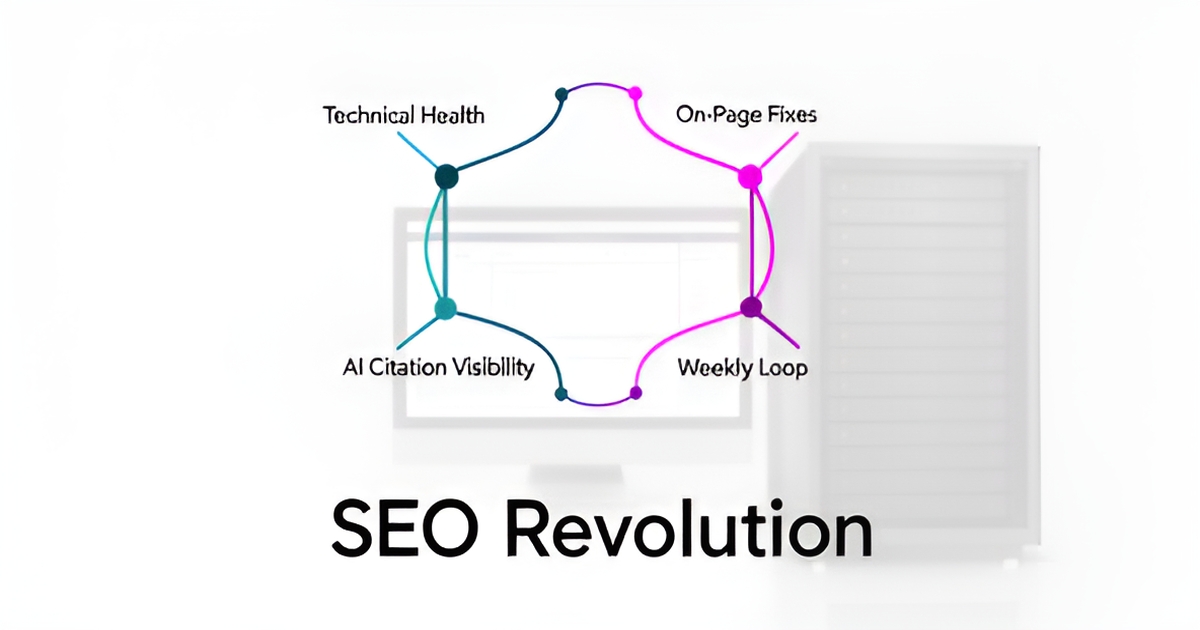
Key facts
- 58.5% of US Google searches ended without a click in 2024, and AI Overviews are accelerating the trend according to recent industry research.
- Position 1 click-through rates drop roughly 54% when an AI Overview appears on the results page, per Ahrefs data.
- Roughly 80% of pages cited by ChatGPT, Claude, and Perplexity don't rank in Google's top 10, so rank tracking alone misses AI visibility research shows.
- Only 32% of website owners allow AI platform access, while 11% actively block AI scrapers — many by accident, per aggregated SEO benchmarks.
- 86% of SEO professionals integrated AI into their workflows in 2025, up from 65% in 2024 industry surveys found.
- Fewer than 20% of firms with four or fewer employees use AI at all, US Census Bureau data shows.
- Content of 3,000+ words earns roughly 3x more traffic and 3.5x more backlinks than short posts, SEO benchmarks confirm.
WANT RESULTS LIKE THIS?
Imagine a system doing all of this for your local business — every day, without you.
We build local businesses a custom website with a team of AI behind it: every lead captured and followed up, new content published monthly,customers finding you on Google — live in 7 days.
- 85+ pages at launch
- Every lead followed up, automatically
- Your whole business on one screen
Why Your Rankings Are Lying to You: The New SEO Reality
If your rank tracker says you're winning, you might be losing and not know it. Classic rank tracking measures a search landscape that started dissolving the moment AI answers began appearing above the blue links.
The numbers tell the story. According to recent industry research, 58.5% of US Google searches ended without a click in 2024, and AI Overviews are accelerating the trend — position 1 click-through rates drop roughly 54% when an AI Overview appears on the results page. Your page can hold the top spot while the click quietly disappears.
The deeper problem is that AI engines don't read from Google's playbook. The same research found that roughly 80% of pages cited by ChatGPT, Claude, and Perplexity don't rank in Google's top 10 for the same query. Meanwhile, Semrush identifies AI search health — whether AI crawlers can even access and parse your pages — as the newest of the four audit categories, and one most audits still skip entirely.
That means most entrepreneurs are auditing for a search engine that no longer fully describes where their customers actually are. A page can be indexed by Google yet still be invisible to the AI platforms answering your customers' questions.
What a modern audit has to cover now:
- Classic rankings — Google and Bing positions, the baseline you already track
- AI citation visibility — whether ChatGPT, Perplexity, Google AI Mode, and Gemini recommend you, and how often versus competitors
- AI crawler access — whether robots.txt and site structure let AI platforms read your pages at all
- Content citability — formatting, schema, and structure that AI answers can actually parse and quote
The competitive gap is real. Fewer than 20% of firms with four or fewer employees use AI at all, per US Census Bureau data, while 86% of SEO professionals have already integrated AI into their workflows. Small business owners who build an AI-aware audit routine are ahead of most of their peers — and behind only the pros.
This is why the workflow in this article treats AI citation monitoring as a first-class audit step, not an afterthought. It's also why managed systems like AI Business Sites track AI-citation share of voice across ChatGPT, Perplexity, and Google AI Mode alongside traditional rankings — because rankings alone will lie to you.
The Four-Pillar Audit: Technical, On-Page, Crawl, and AI Search Health
Most entrepreneurs still run a three-pillar SEO audit — technical, on-page, and indexing — and then wonder why their traffic is flat while AI answers eat the clicks. The modern audit has four pillars, not three, and the fourth one is the one your competitors probably haven't checked yet.
Pillar 1: Technical health. This is the foundation: Core Web Vitals, HTTPS, mobile-friendliness, and schema markup. Structured data errors here silently suppress everything downstream, including how AI systems parse your pages. A crawl of 100 pages takes roughly three minutes with a mainstream audit tool, so there's no excuse for skipping it, as hands-on tool testing shows.
Pillar 2: On-page and content. This covers metadata, heading structure, internal links, and keyword targeting. The common findings are predictable: thin content, duplicate pages, orphan pages, and metadata gaps. It matters more than it used to — Google is 57% more likely to rewrite overly long meta titles, and 25% of top-ranking pages lack meta descriptions entirely, according to aggregated SEO benchmarks.
Pillar 3: Crawl and indexing coverage. Your robots.txt, sitemaps, and index coverage decide whether Google can even find you. Start in Google Search Console: inspect the key page, check the "Page indexing" report for "Crawled – currently not indexed" URLs, and look for patterns in the Core Web Vitals reports before touching anything else.
Pillar 4: AI search health — the new pillar. This asks two questions: can AI crawlers reach your pages, and can ChatGPT, Claude, Perplexity, and Google AI Mode actually parse and cite them? The distinction matters because a page can be indexed by Google but still be invisible to AI platforms. And the stakes are real:
- Only 32% of website owners allow AI platform access, while 11% actively block AI scrapers — many by accident.
- Roughly 80% of pages cited by ChatGPT, Claude, and Perplexity do not rank in Google's top 10 for the same query, so rank tracking alone misses AI visibility.
- Dedicated AI search checks remain uncommon in audit tools, so most scans won't flag a blocked GPTBot for you.
The practical workflow is the same regardless of tooling: pick the audit type first — not the most powerful tool — then run the scan, then act on prioritized fixes with human sign-off on each batch. Tools that explain what to change, rather than just listing problems, are worth the premium.
For business owners who'd rather not run this loop manually every week, managed options exist: AI Business Sites, for example, bundles an SEO Growth Engine into its monthly plan that tracks both Google rankings and AI-citation share of voice across ChatGPT, Perplexity, and Google AI Mode, then files a weekly report of what changed and what's next. Whether you audit with a tool, a team, or a managed system, the four-pillar structure is what turns a one-time scan into a repeatable process.
The Step-by-Step Workflow: From Search Console to Signed-Off Fixes
Before you touch a single AI tool, decide what kind of audit you're running. As Semrush's hands-on testing puts it, the best audit tool isn't the most powerful one — it's the one that matches the audit you need to run, whether that's technical, on-page, crawl/indexing, or the newest pillar: AI search health.
Step 1: Start with Google Search Console. It's free, it's your own data, and it tells you where the real problems are. Check the "Page indexing" report for URLs marked "Crawled — currently not indexed," and review your Core Web Vitals reports for patterns across pages rather than one-off dips. If a key page suddenly drops, use URL inspection first — it often explains the drop before any paid tool does.
Step 2: Run an automated scan. Modern AI audit tools are fast — a typical free scan completes in about two minutes with roughly five minutes of setup. The goal isn't a 400-line problem list; it's findings ranked by potential traffic gain. Look for the common culprits: weak headings, thin content, broken links, duplicate pages, orphan pages, structured data errors, and metadata gaps.
Step 3: Add the AI-citation check. This is the step most entrepreneurs skip. Roughly 80% of pages cited by ChatGPT, Claude, and Perplexity don't rank in Google's top 10 for the same query — so classic rank tracking alone misses AI visibility entirely. Verify that AI crawlers can actually access your pages (only 32% of website owners currently allow AI platform access), and check whether your content is structured to be parsed and cited.
Step 4: Apply fixes in prioritized batches, with human sign-off on each. This is where AI earns its keep — and where it still needs you. The proven pattern is to work through batches:
- Title tags and meta descriptions — quick wins with measurable click-through impact
- Schema markup, including underused Speakable schema for AI assistants
- Broken links and redirects
- Internal links that build topical clusters
- Content reworks using the GEO playbook: answer the question in the first sentence, use listicle or how-to formats, and include named statistics with sources
The human sign-off matters because AI's weak spot is fact-checking and strategy — it confidently asserts plausible-looking but wrong claims. Keep people on strategy, original research, and verification; delegate the repeatable, reversible fixes to the machine.
For owners who'd rather not run this loop themselves, done-for-you systems exist — AI Business Sites, for example, includes an SEO Growth Engine in its $497/month plan that runs a weekly measure-target-edit-publish-report loop with rank tracking and AI-citation monitoring across ChatGPT, Perplexity, Google AI Mode, and Gemini. Either way, the sequence is the same: diagnose from your own data first, scan second, and never let a batch of fixes ship unreviewed.
Local business: doing this the old way?
One system replaces the whole pile.
All of it — the website, the follow-up, the content, the leads — built and run for you for $1,497 + $497/mo. Month-to-month, and you own everything.
See what your build includesFixing What the Audit Finds: The GEO Content Checklist
Your audit will hand you a list of content gaps — thin pages, missing schema, questions your site never answers. What separates a useful audit from a shelf document is what you do next, and the emerging playbook for that fix is called GEO: Generative Engine Optimization. It's how you get cited inside AI answers, where roughly 80% of pages cited by ChatGPT, Claude, and Perplexity don't even rank in Google's top 10 for the same query.
Start every rewrite by answering the question in the first sentence. AI engines extract passages, not paragraphs of context, so a page that buries its answer three headings deep loses to one that leads with it. Format matters too: over 40% of LLM-cited content uses listicle or how-to formats, with a clean heading hierarchy that machines can parse.
Your GEO content checklist, in priority order:
- Answer the target question in the first sentence of the page, then expand.
- Use listicle and how-to structures with clear heading hierarchy.
- Add aggressive schema markup — including underused Speakable schema for voice and AI assistants.
- Include named statistics with sources; AI engines favor verifiable, citable claims.
- Consolidate thin pages into fewer, deeper resources instead of publishing more.
That last point is not optional. Google's scaled content abuse policy, enforced since May 2024, explicitly deindexes AI-generated volume-without-value content — and by April 2025, 74% of newly created web pages contained AI-generated material, so the filter is working overtime. Depth wins: 3,000+ word content earns roughly 3x more traffic and 3.5x more backlinks than short posts. Ten deep pages beat fifty shallow ones.
Where does AI stop and the human begin? AI excels at the repeatable work — drafting, on-page optimization, schema markup, citation tracking. Humans keep strategy, original research, and fact-checking, because AI confidently asserts plausible-looking but wrong claims, and a hallucinated statistic on your page is a credibility problem you own. That's why managed systems like AI Business Sites build verification into the pipeline — every claim checked against primary sources before publication — rather than assuming the model got it right.
The line is simple: delegate the repeatable, keep the judgment. An entrepreneur who applies this checklist to their audit findings — with a human approving every batch of fixes — turns a diagnostic report into a compounding visibility asset across both classic rankings and AI answers.
Running the Loop Every Week — Without Running It Yourself
A one-time audit is like a single workout: useful, but the results come from the routine. The problem is that most entrepreneurs can't spare a morning every week to re-run crawls, check rankings, and chase AI citations — and the data says they're not. According to U.S. Census Bureau survey data, fewer than 20% of firms with four or fewer employees use AI at all, while overall business adoption sits between 17% and 20%.
That gap is the opportunity. Meanwhile, 86% of SEO professionals integrated AI into their workflow in 2025 — up from 65% in 2024 — meaning agencies and bigger competitors are already running this loop weekly. A small business that audits once and stops is competing against teams that measure continuously.
The weekly loop itself is simple on paper:
- Measure — pull rank movements, traffic, and AI-citation share across ChatGPT, Perplexity, and Google AI Mode
- Target — pick one keyword cluster worth winning this week
- Edit — refresh the decaying page or inject internal links toward it
- Publish — ship the fix or the new piece targeting that cluster
- Report — note what moved, what didn't, and what to try next week
The AI-citation step matters most. Research shows roughly 80% of pages cited by ChatGPT, Claude, and Perplexity don't rank in Google's top 10 for the same query — so classic rank tracking alone misses where a growing share of buyers now get answers.
Running this by hand takes hours most owners don't have, which is exactly why the loop should run you, not the other way around. This is where a done-for-you option earns its keep: AI Business Sites includes an SEO Growth Engine that runs the full measure→target→edit→publish→report cycle weekly — Google and Bing rank tracking, AI-citation monitoring across ChatGPT, Perplexity, Google AI Mode, and Gemini, and a weekly growth report landing in the owner's inbox. The owner reads one email; the system does the work.
The honest framing from the research still applies: AI handles the repeatable, structured tasks, while strategy and fact-checking stay human. A weekly loop — whether you build it yourself or have it run for you — keeps a human in that seat while the machines do the crawling. For businesses with four or fewer employees, simply having the loop at all puts you ahead of more than 80% of your peers.
Frequently Asked Questions
Why do my Google rankings look good but my traffic keeps dropping?
Do I need to check AI visibility separately from Google rankings?
What are the four pillars of a modern SEO audit?
Could my site be accidentally blocking AI crawlers like ChatGPT?
What content format gets cited most often in AI answers?
Should I let AI write all my SEO content after the audit?
Is it too late for a small business to catch up on AI SEO?
Your Rankings Aren't the Whole Story Anymore
The audit workflow in this article comes down to four moves: diagnose from your own data in Google Search Console, run an automated scan across the four pillars, add the AI-citation check most entrepreneurs skip, and ship fixes in prioritized batches with a human signing off every one. Then repeat it weekly — because roughly 80% of pages cited by ChatGPT, Claude, and Perplexity don't rank in Google's top 10, a one-time audit built on rank tracking alone leaves most of your visibility unmeasured. The good news is the gap works in your favor: fewer than 20% of small firms use AI at all, so simply running this loop puts you ahead of most of your peers. If the weekly measure-target-edit-publish-report cycle sounds like more than a Tuesday can hold, that's exactly the work AI Business Sites runs for clients — an SEO Growth Engine that tracks rankings and AI citations across ChatGPT, Perplexity, Google AI Mode, and Gemini, then files a weekly report. Or book a free strategy call and talk through what your audit found. Either way, start with Search Console this week — it's free, and it's already telling you where the problems are.
FOR local businesss — BUILT AND RUN BY US
Your website. Your content. Your leads. Your data.
$500 starts your build. Seven days later it's live — chat, booking, follow-up, and your Google presence all set up. Then we run it, every month. You do the work you actually get paid for.