
Key facts
- 67% of consumers now prefer booking online — up from 56% in 2021 — yet only 23% of local service businesses offer it, according to industry booking data.
- 40% of online bookings happen outside business hours, and 33% of bookers have booked at midnight or later, booking research shows.
- 48% of clients say a difficult booking experience would push them to a competitor, per booking research.
- SMS reminders cut no-shows by 29–39%, and requiring deposits reduces them by 40% or more, according to booking-system research.
- Businesses that add online booking see an average 37% increase in bookings within the first six months, industry data finds.
- Collecting payment online at booking correlates with 23% higher revenue per appointment, research on booking systems shows.
- Businesses with online booking receive 3.2x more Google reviews, booking research finds.
WANT RESULTS LIKE THIS?
Imagine a system doing all of this for your local business — every day, without you.
We build local businesses a custom website with a team of AI behind it: every lead captured and followed up, new content published monthly,customers finding you on Google — live in 7 days.
- 85+ pages at launch
- Every lead followed up, automatically
- Your whole business on one screen
Phone-Only Businesses Are Quietly Losing Bookings and Orders
Most service business owners think their phone is the front door to their business. In reality, it's a filter — and it's filtering out more revenue than they realize. The customers they never speak to are the ones quietly booking with someone else.
The numbers tell an uncomfortable story. According to industry booking data, 67% of consumers now prefer booking online — up from 56% in 2021 — and 70% will choose a business that offers online booking over one that doesn't. Yet research on local businesses finds only 23% of local service businesses actually offer it. That gap isn't neutral. It's a competitive opening for whoever moves first.
The after-hours problem compounds it. Roughly 40% of online bookings happen outside business hours — evenings, weekends, and, for 33% of bookers, at midnight or later. A phone-only business is closed exactly when a large share of its customers are ready to commit. The voicemail doesn't capture that intent. It just ends it.
Then there's the switching cost. Booking research shows that 48% of clients say a difficult or outdated booking experience would push them to a competitor, and 63% of consumers will switch after a single bad experience. One frustrating phone-tag session — call, miss, call back, miss again — is often all it takes to lose a customer who was ready to spend money.
What that looks like in practice:
- A homeowner finds you on Google at 9pm, can't book, and books the next listing instead
- A caller hits voicemail during a job site visit and never calls back — most don't anymore
- A customer who would have paid a deposit on the spot simply never converts
The revenue math is stark. Businesses that add online booking see an average 37% increase in bookings within the first six months, and in some local-business cases revenue has grown by up to 120%. That's not new demand being created — it's demand that was already there, leaking out through a phone line nobody answered.
This is why AI Business Sites treats booking and ordering as core website functionality, not an add-on: appointment slots drawn from real business hours, orders and bookings taken by chat or voice, and payments flowing directly to the business's own account. The point isn't more software — it's a website that never closes the door on a ready customer. For a phone-only business, every one of these statistics is a mirror. The question isn't whether customers want to book with you online. They already told you they do.
What Renovatly's Store and Booking Capabilities Actually Do
Most website builders treat selling and booking as separate products you pay extra for. Renovatly's growth platform takes the opposite approach: the store and the booking calendar are part of the site itself, built in when your business actually sells something.
The commerce engine runs on four catalog types. A business can run one or mix several — a tour company selling merchandise, bookable tours, and event tickets gets all three catalogs on a single site with one admin:
- Products — physical goods with delivery zones, fees, and order minimums
- Services — bookable appointments with real time slots and per-slot capacity
- Menus — restaurant ordering with pickup, delivery, or dine-in, plus tips at checkout
- Tickets — dated events with seat-counted slots per showing
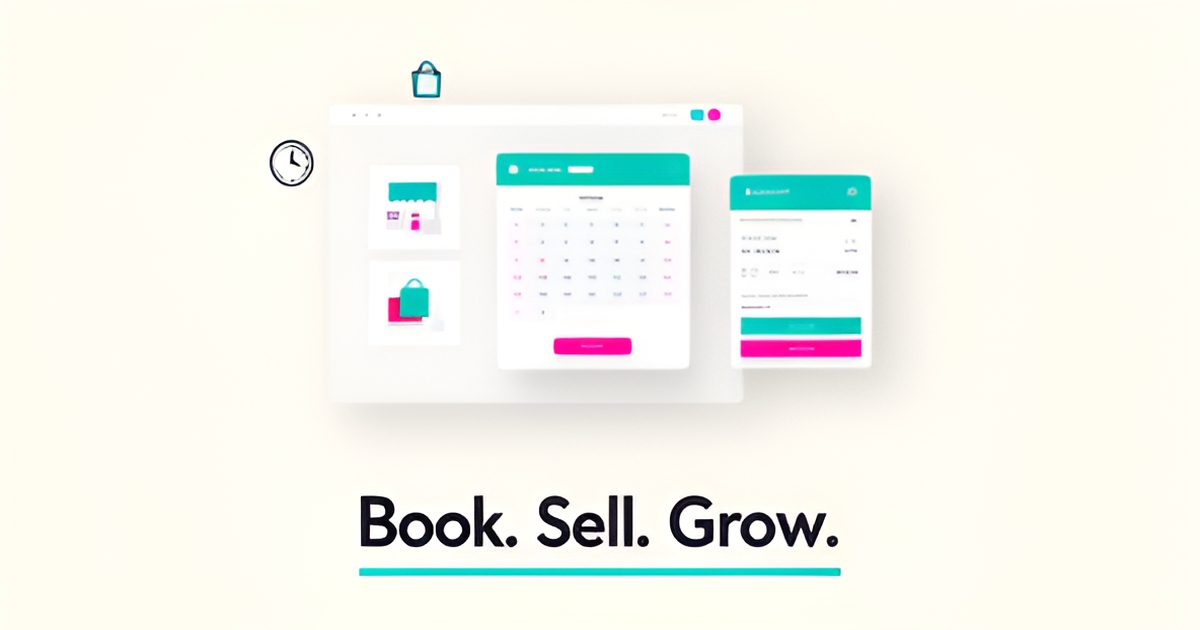
Appointment booking isn't a bolted-on calendar widget. Slots are generated natively from the business's actual hours and capacity — one salon chair or twelve tour seats — with timezone-correct availability and overbook protection that simply blocks a full slot. That matters because booking research shows 40% of online bookings happen outside business hours, and a phone-only business quietly loses them.
Payments run through Stripe Checkout into the client's own account. The platform never touches the money — card checkout happens on the site, payment is webhook-verified, and the receipt goes out automatically. Beyond transactions, the engine handles waitlists on full slots, gift cards with code-based balances, visit packages, and recurring memberships with member discounts and priority booking.
The part that surprises most owners: customers can order or book by chat or voice. The FAQ bot and the site's voice agent both carry the catalog, so someone can reserve a table or buy a ticket by talking to the website — no form, no login. Given that only 23% of local service businesses offer online booking while most customers prefer it, that's a genuine edge.
Contrast this with the standard builder playbook. Ecommerce is typically gated behind upgraded plans — pricing reviews put those upgrades at $20.99 to $29 per month — and booking often means a separate scheduling subscription starting around $16 monthly. Here, the store, the menus, the bookings, and the tickets are included capabilities, set up by the team rather than assembled by you.
AI Business Sites builds this ordering and booking layer into the site when the business needs it — products, food, appointments, or tickets — rather than handing over another dashboard to learn. If you sell things, the selling gets built in.
Local business: doing this the old way?
One system replaces the whole pile.
All of it — the website, the follow-up, the content, the leads — built and run for you for $1,497 + $497/mo. Month-to-month, and you own everything.
See what your build includesThe ROI: Fewer No-Show, More Revenue, Better Reviews
The math behind online booking and selling is straightforward: fewer empty appointment slots, higher revenue per booking, and a steady stream of new Google reviews. Each of these outcomes has solid research behind it — and each maps to a feature the Renovatly platform builds into your site.
Start with no-shows. Across service industries, the average no-show rate sits at 10–15%, and every missed appointment is revenue you already counted on. Research on booking systems found that SMS reminders cut no-shows by 29–39%, while requiring deposits reduces them by 40% or more — deposit-requiring businesses see no-show rates of 5–7% versus 12–18% without one. SMS works because it gets read: 98% open rate, with 90% read within three minutes.
Renovatly delivers both levers natively. Booking slots come from your actual business hours and per-slot capacity, with automated reminders — including T-24h and T-1h emails and SMS notifications — plus self-service reschedule links that let customers fix their plans instead of silently not showing. For deposits, Stripe checkout collects payment at booking through your own account, so the money lands directly with you.
That payment-at-booking detail matters beyond no-show prevention. The same research found that collecting payment online at booking correlates with 23% higher revenue per appointment — customers who've already paid show up, spend more, and cancel less. Renovatly's commerce engine supports this across products, bookable services, menus, and event tickets, all through the same Stripe-backed checkout.
Then there's the review flywheel. Businesses with online booking receive 3.2x more Google reviews, largely because the booking itself creates a natural follow-up moment. Renovatly closes that loop automatically: after a job completes or an invoice is paid, the system sends the review request with a direct Google review link — no sticky note, no manual chase.
The payoff adds up like this:
- SMS reminders cutting no-shows by 29–39% keeps your calendar full without extra admin work
- Deposits collected at booking reducing no-shows by 40%+ while protecting your revenue upfront
- Payment at booking correlating with 23% higher revenue per appointment
- 3.2x more Google reviews, compounding your local search visibility over time
None of this requires you to learn another tool. Renovatly builds the store, booking pages, reminders, and review requests into your site and manages them for you — you approve what needs approving and run your business. The ROI isn't a promise; it's what happens when the system actually runs the loop end to end.
Getting Your Store and Booking System Live
Most website builders treat selling and booking as an upsell — you build the site, then bolt on commerce later. Renovatly flips that. When a business sells something, the store and booking system are built into the site by the team during the build, not left for the owner to configure alone.
That matters because the market data is unambiguous: consumers now expect to buy and book online, yet only 23% of local service businesses actually have an online booking system, according to industry research. Meanwhile, roughly 67% of consumers prefer booking online, and 40% of online bookings happen outside business hours — appointments a phone-only business simply never captures.
Here's how the implementation actually works.
The kickoff. Everything starts with a deposit and a short questionnaire about the business — what it sells, its services, its customers. That's the homework. From there, the team determines which commerce setup fits: an online store for products, restaurant online ordering, bookable services, event tickets, or a mix. A tour company selling merch and tickets can run multiple catalogs on one site with one admin.
What to prepare. Very little. The business supplies its real offerings, hours, and pricing. The team handles the rest — product setup, menu structure, service slots derived from actual business hours and per-slot capacity, delivery zones, and the booking pages that live on the client's own domain.
Payments. Card checkout runs through Stripe Checkout connected to the client's own Stripe account. Money flows directly to the business — the platform never touches funds. Cash-on-delivery can run alongside it.
Launch. The whole site — store, booking, and everything else — goes live in 7 days from kickoff, with the client approving the build before it publishes. After launch, the practical details are handled natively: automated reminders that research shows can cut no-shows by 29–39%, waitlists when a slot fills, and self-service rescheduling links for customers.
This is where AI Business Sites differs from the tier-gated norm. Many builders require upgraded plans for ecommerce — GoDaddy, Webflow, and Wix all gate selling behind plans costing $20.99–$29 per month, and Squarespace needs a separate booking subscription from $16/month. Here, if the business sells, the ordering and booking are built in as part of the one setup and one monthly fee — set up by the team, never self-serve.
The result: a business owner who never touches a technical tool gets a site that takes orders, books appointments, and collects payment — live within a week.
If you sell products, food, services, or tickets and want that built into your site properly, book a free strategy call — 30 minutes, no obligation, just a real conversation about what your business needs.
Frequently Asked Questions
Do I really need online booking if customers can just call me?
How much revenue can a business gain from adding online booking?
What can Renovatly's store and booking system actually sell?
Can customers order or book without filling out a form?
How does online booking reduce no-shows?
How is this different from Wix or Squarespace with a booking add-on?
Stop Losing the Customers Who Were Ready to Buy
The pattern across every statistic in this article is the same: the demand already exists, and it's going somewhere. Two-thirds of consumers prefer booking online, 40% of bookings happen after hours, and businesses that add online booking see an average 37% increase in bookings within six months. The only question is whether that demand lands on your calendar or a competitor's. If you sell products, food, services, or tickets, the store, booking calendar, reminders, and Stripe payments can be built directly into your site — set up by the team at AI Business Sites, not assembled by you from separate subscriptions. You never touch a technical tool. The site goes live in 7 days, takes orders and appointments around the clock, and collects payment into your own account. The businesses winning right now aren't the ones with better phones — they're the ones whose websites never close. If that's the gap in your business, book a free 30-minute strategy call. No obligation, no pitch — just an honest conversation about what your business needs.
FOR local businesss — BUILT AND RUN BY US
Your website. Your content. Your leads. Your data.
$500 starts your build. Seven days later it's live — chat, booking, follow-up, and your Google presence all set up. Then we run it, every month. You do the work you actually get paid for.