
Key facts
- Leads contacted within 5 minutes are 21x more likely to qualify than those contacted after 30 minutes, per the MIT Lead Response Management Study.
- 63% of businesses never respond to inbound leads at all, and only 17% respond instantly, according to 2024 research.
- Mid-size construction firms lose an estimated $50,000 to $500,000 annually to slow lead follow-up, industry analysis finds.
- Automated lead routing cuts assignment time from 5–15 minutes to roughly 5 seconds, routing research shows.
- Automated systems achieve 99% follow-up consistency versus just 60–70% for manual processes, according to benchmark data.
- Firms with structured lead tracking improve close rates by 15–25% over manual methods, construction industry research reports.
- 35–50% of B2B sales go to the vendor that responds first, per a Google and CEB white paper.
WANT RESULTS LIKE THIS?
Imagine a system doing all of this for your local business — every day, without you.
We build local businesses a custom website with a team of AI behind it: every lead captured and followed up, new content published monthly,customers finding you on Google — live in 7 days.
- 85+ pages at launch
- Every lead followed up, automatically
- Your whole business on one screen
Why Good Leads Go Cold: The Speed-to-Lead Problem
A homeowner fills out your quote form at 9 a.m. on a Tuesday. By lunch, they've contacted two more contractors. If nobody called them back by then, you likely lost the job — and never knew it existed.
That's the hidden revenue leak in most renovation businesses. Leads arrive by form, phone call, or website chat, then sit unanswered while the crew is on a job site. The numbers behind this are stark. Research on lead routing found that leads contacted within 5 minutes are 21x more likely to qualify than those contacted after 30 minutes, based on the MIT Lead Response Management Study. The same research found that 63% of businesses never respond to inbound leads at all — and only 17% respond instantly.
For renovation contractors, the cost is measurable. Mid-size construction firms lose an estimated $50,000 to $500,000 annually to slow follow-up, according to industry analysis of construction lead management. Most of these firms also burn 6–10 hours per week manually tracking leads — hours that could go to estimating and building.
Here's the important part: this isn't a laziness problem. It's a systems problem. The typical renovation business owner isn't sitting at a desk waiting for the phone to ring. They're on a roof, in a crawlspace, or driving between estimates. Manual follow-up breaks down for predictable reasons:
- A lead arrives while the owner is mid-job, and the response window closes before they check their phone
- No single place tracks which leads have been contacted and which are still waiting
- Quotes go out but never get a follow-up nudge, so warm prospects quietly go cold
- Overflow from busy weeks simply never gets worked at all
The fix isn't working harder — it's removing the human bottleneck from the first-response step. Automated lead routing can cut assignment time from 5–15 minutes to roughly 5 seconds, every time, without depending on someone being available. Systems like the CRM built into an AI Business Sites site capture every lead from forms, chat, and bookings instantly, send a branded response within seconds, and alert the owner by email or SMS so the first touch happens even when they're up a ladder.
Speed to lead is one of the strongest predictors of conversion in any sales-driven business. For contractors, the winners aren't the ones with the best brochure — they're the ones who answer first.
How Automated Lead Routing Actually Works
Speed decides who wins the job. When a homeowner fills out a quote request at 8pm, the renovation company that responds first is usually the one that gets the contract — and industry research shows automated routing cuts assignment time from 5–15 minutes down to roughly 5 seconds, every single time.
Automated routing isn't one technique — it's a set of models that mature systems layer together. According to a lead routing guide from LeanData, six models cover most real-world setups:
- Round robin — leads rotate evenly across reps so no one is overloaded or idle
- Territory-based — leads route by geography, so the closest team handles them
- Account-based — existing customers route to their owner, not a stranger
- Campaign-based — leads from a specific promotion go to the team built for it
- Time-based SLA — if a lead sits unclaimed too long, it reroutes automatically
- Capacity-based — a rep at their daily limit is skipped until capacity frees up
Underneath these models sits a three-layer rule structure. Layer one is the firmographic must-match: geography, industry, and company size determine which pool a lead even qualifies for. Layer two optimizes for outcome, weighing lead score, source quality, and deal size. Layer three handles operational reality — rep availability and capacity.
The numbers explain why this matters. One person manually routing leads tops out at roughly 100–150 leads per day, and manual processes achieve only 60–70% follow-up consistency, while automated systems reach 99%. Manual routing works fine at ten leads a day; at 50 or more, leads go unassigned, response times balloon, and reps cherry-pick the easy ones.
There's a warning worth heeding, though: fallback rules. As one routing analysis puts it bluntly — without fallback logic, leads get stuck, and stuck leads die. If every eligible rep is at capacity or out of territory, a system without exception handling simply parks the lead in limbo. Good routing engines define what happens next: escalate to a manager, widen the territory, or queue with an SLA timer.
This is the same logic we apply at AI Business Sites when configuring a client's CRM — every lead captured by a form, chat, or voice call lands with an owner and a follow-up within seconds, not hours. For a renovation business, that difference is often the whole ballgame.
Local business: doing this the old way?
One system replaces the whole pile.
All of it — the website, the follow-up, the content, the leads — built and run for you for $1,497 + $497/mo. Month-to-month, and you own everything.
See what your build includesThe Dashboard as Your Visual Control Center
A renovation business can lose more jobs at the follow-up stage than at the quoting stage. Industry research on home services CRMs finds that many jobs are lost simply because a quote was never followed up on — the customer was ready, but nobody called back (Nutshell). The dashboard is where that silent leak becomes visible before it costs you the job.
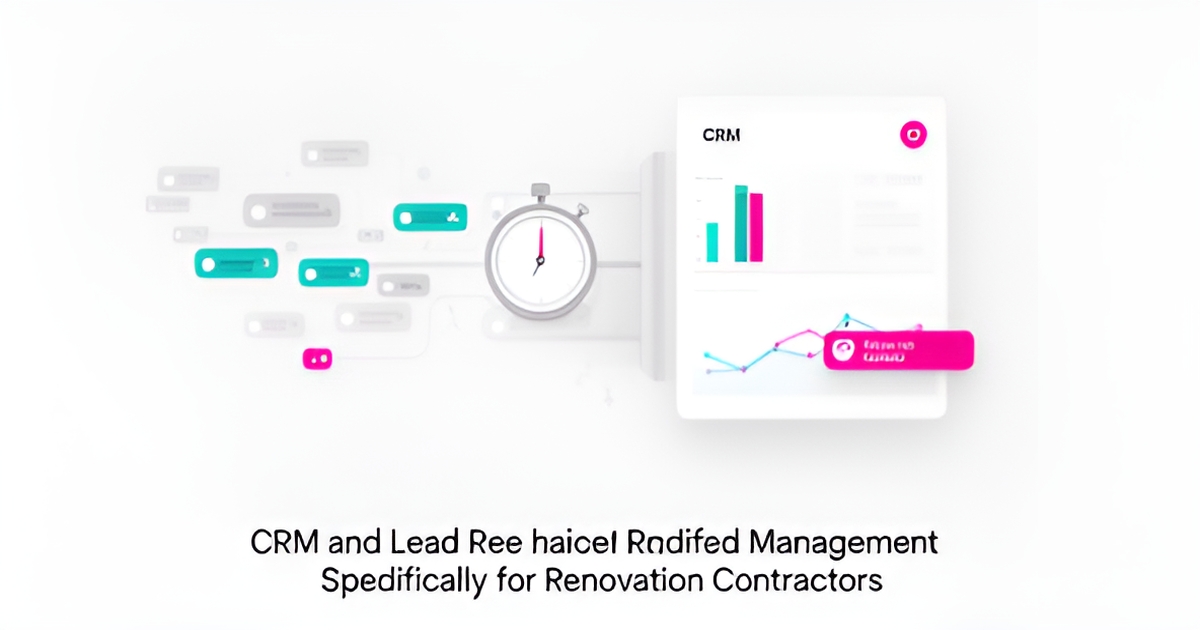
A good CRM dashboard works as a visual control center — charts, pipeline boards, and real-time updates in one place, so you can prioritize outreach at a glance. The strongest dashboards for renovation and home-services businesses share four elements:
- Color-coded lead scores — green for hot, amber for warming, red or gray for cold, so the next call is obvious without reading a single note.
- Pipeline stage progression — a Kanban-style view showing whether a lead is a new inquiry, a quoted job, or a negotiation waiting on a decision.
- Engagement metrics — email opens, clicks, calls, and booked meetings that reveal which quotes are actually being looked at.
- SLA flags — leads stuck beyond a 48–72 hour window get flagged for review, because consistent scoring and flagging can speed first contact by up to two weeks.
The payoff from this level of visibility is measurable. Firms that adopt structured lead tracking see close rates improve by 15–25% over manual methods, and 78% of construction firms admit that lead tracking and follow-up is a top operational weakness (US Tech Automations). In an industry where the average contractor submits 4–8 bids for every job won, the difference between a 22% and 31% close rate is the difference between a growing calendar and a shrinking one.
Dashboards also solve a quieter problem: cherry-picking. When leads sit in a shared pool, reps naturally grab the ones that look most valuable — and skip the rest. As one expert quoted by Workato puts it, if certain lead categories are perceived as less valuable, those leads "may be the last to be worked and may even be skipped altogether" (Workato). The fix isn't more supervision; it's transparent rules. When scoring criteria and routing logic are explicit and visible on the dashboard, every lead carries the same weight and gets the same treatment — no bias, no forgotten inquiries.
That transparency is the philosophy behind how AI Business Sites builds CRM dashboards for service businesses: the visual layer exists to show what needs attention, while automated routing and follow-up make sure the attention actually happens. The dashboard answers "who next and how" — the system handles the rest.
What Renovation Owners Should Look For (and How to Set It Up)
Most renovation owners don't lose jobs to better contractors — they lose them to faster ones. A renovation firm that automates lead follow-up responds roughly 5× faster than one relying on sticky notes and memory, and that speed difference shows up directly in signed contracts, according to construction industry research.
Before you buy anything, run every CRM through a short checklist. Here's what actually matters for a renovation business.
1. Instant capture from every source. Your leads arrive from website forms, chat widgets, phone calls, and booking pages — often while you're on a job site. A CRM that only catches form submissions misses half the pipeline. Look for a system where every channel creates a lead record automatically, the moment it happens.
2. Branded auto-responses within seconds. The research here is blunt: leads contacted within 5 minutes are 21x more likely to qualify than those contacted after 30 minutes, per the MIT Lead Response Management Study. Yet 63% of businesses never respond to inbound leads at all. An automatic, branded acknowledgment — "Thanks, Mike from Summit Renovations here, your quote is coming" — buys you that window even when you're up a ladder.
3. Routing rules with a round-robin fallback. Manual assignment works at ten leads a day and collapses at fifty. Automated routing cuts assignment time from 5–15 minutes to about 5 seconds, and routing research is clear on the failure mode: "Without fallback logic, leads get stuck. Stuck leads die." Your rules should match geography and job type first, then default to even round-robin distribution so nothing sits unassigned.
4. Follow-up sequences after quotes. In home services, many jobs are lost simply because a quote was never followed up on — a gap Nutshell's home services research identifies as one of the most expensive in the trade. Insist on automated day-3 and day-7 nudges on every sent quote.
- Every source — forms, chat, calls, bookings — creates a CRM lead instantly
- Branded auto-response fires within seconds, day or night
- Routing rules layer geography and job type, with round-robin as the safety net
- Quote follow-up sequences run automatically until the lead answers or closes
- A dashboard that flags aging leads past a 48–72 hour SLA for review
Then there's the implementation question — and the honest part most vendors skip. Construction CRMs typically run $49/month for a single user up to $500+/month at enterprise, with Buildertrend at $299–$499 and per-seat tools stacking add-ons for reviews and e-signature. You pay that, and you still have to build the routing rules yourself on a Saturday night.
That's the trade-off worth naming: configuration versus done-for-you. A platform like AI Business Sites takes the opposite path — its $497/month managed system includes a CRM with pipelines, Kanban deal boards, instant lead capture, and automated follow-up, all set up by the team rather than assembled by you. The routing rules, the response templates, the quote sequences: configured at launch, not left as homework.
Whichever route you choose, the standard is the same. If a lead can arrive at 9:40 on a Tuesday and get a branded response, a routing decision, and a follow-up plan without you touching anything — you've bought the right system.
The Contractor Who Answers First Wins — Make Sure It's You
Every renovation business has the same silent leak: leads that arrive while the owner is on a ladder, sit unanswered, and quietly hire someone else. The research is blunt — leads contacted within 5 minutes are 21x more likely to qualify than those left waiting 30 minutes, yet 63% of businesses never respond at all. The fix isn't working harder; it's a system that captures every lead instantly, sends a branded response within seconds, routes it with fallback logic so nothing dies in limbo, and follows up on every quote automatically. A good dashboard then shows you who's hot, who's aging, and who needs a call today. You can assemble that yourself from a $49/month tool on a Saturday night, or have it configured for you — that's the choice AI Business Sites was built around: a managed system where the routing rules, response templates, and follow-up sequences are set up at launch, not left as homework. Either way, the standard is simple: if a lead can arrive at 9:40 on a Tuesday and get a response, a routing decision, and a follow-up plan without you touching anything, you've got the right system. Want to see what that looks like for your business? Book a free strategy call — 30 minutes, no obligation, no sales pitch.
FOR local businesss — BUILT AND RUN BY US
Your website. Your content. Your leads. Your data.
$500 starts your build. Seven days later it's live — chat, booking, follow-up, and your Google presence all set up. Then we run it, every month. You do the work you actually get paid for.