
Key facts
- 83% of top organic local results have a dedicated location page according to 2026 local SEO data
- Consumer use of AI tools for local recommendations jumped from 6% to 45% in a single year per 2025–2026 local search data
- City-swap template pages get treated as doorway pages and either fail to rank or get de-indexed entirely per contractor SEO analysis
- Each location page needs 40–60% unique content as the minimum to justify its own URL according to BrightLocal's framework
- 31% of consumers will only consider businesses rated 4.5 stars or higher, nearly double last year's threshold research shows
- A plumber ranking #1 at the shop may rank #17 twelve miles away because service-area businesses are ranked by proximity Search Engine Land explains
- Local organic traffic converts at 3.8x the rate of non-local organic traffic according to local SEO statistics
WANT RESULTS LIKE THIS?
Imagine a system doing all of this for your local business — every day, without you.
We build local businesses a custom website with a team of AI behind it: every lead captured and followed up, new content published monthly,customers finding you on Google — live in 7 days.
- 85+ pages at launch
- Every lead followed up, automatically
- Your whole business on one screen
The Doorway-Page Trap: Why Swapped City Names Kill Rankings
Every niche trade eventually discovers the same shortcut: build one page, swap the city name, repeat for every town in the service area. It feels efficient — until Google quietly removes the pages from its index and the phone stops ringing.
The problem has a name. Duplicated template city pages with just the city name swapped in get treated as doorway pages and either fail to rank or get de-indexed entirely. Google sees right through the pattern, and as local SEO practitioners point out, it actively hurts your rankings instead of helping them. One strong location page with genuine local insights beats ten duplicate pages every single time.
The test is simple: if you cannot tell which city a page is about without reading the headline, Google cannot either. A dumpster company's page for Springfield should read differently than its page for Shelbyville — different neighborhoods, different permit quirks, different job photos, different reviews naming that suburb. Each page needs to earn its URL, as BrightLocal's framework puts it, with roughly 40–60% unique content as the minimum to justify a separate URL.
AI search has raised the stakes further. AI search hasn't changed the basic job of a location page — it has made weak pages harder to justify. With 45% of consumers now using AI tools for local recommendations, up from 6% a year earlier, generic city-swap content struggles even more because AI systems have little location-specific information to cite. The pages that win in AI answers are the ones dense with citable local facts.
Here is where the opportunity sits. According to local SEO statistics, 83% of top organic local results have a dedicated location page — yet many local competitors, as Search Engine Land observes, "simply aren't doing a stellar job" with them. The tactic is proven; the execution across most niches is poor.
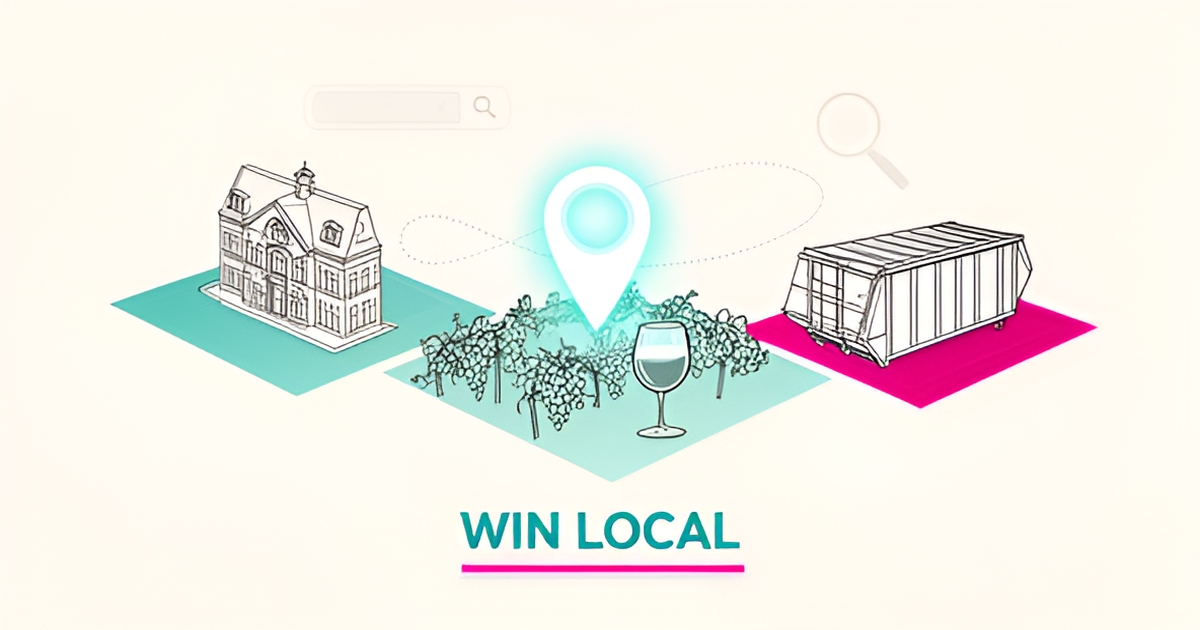
For architects, wineries, and dumpster services, that gap is the opening:
- Architects can build city pages around real project portfolios — the completed renovations in one town justify a page no template can fake.
- Wineries can anchor location pages in tasting-room visits, driving directions, and regional terroir that only apply to that place.
- Dumpster services can pair service-area pages with reviews that name the suburb and photos with genuine location context.
This is exactly why AI Business Sites builds location pages from researched, location-specific inputs — neighborhood names, local landmarks, city-level service notes — rather than a find-and-replace template. The pages that survive Google's doorway-page filter and get picked up by AI search are the ones a real customer in that city would actually find useful.
The Hybrid Playbook: City Pages Where You've Earned Them, Service-Area Pages Everywhere Else
The temptation with location SEO is to generate a page for every city you might serve. The research says that's exactly how businesses get penalized: duplicated template city pages with just the name swapped get treated as doorway pages and either fail to rank or get de-indexed, according to contractor SEO analysis. The winning structure is a hybrid — dedicated city pages only where you've genuinely earned them, and one strong service-area page for everywhere else.
The earning thresholds are specific. A dedicated city page is justified when a business has roughly 50 completed projects in that city and can produce 800+ words of genuinely unique content, per the location page framework popularized in contractor SEO circles. BrightLocal adds a quality floor: each page needs a 40–60% unique-content minimum to justify its own URL — a page should exist because it helps a real customer, not because there's a city name to rank for. Their simple test: if you can't tell which city a page is about without reading the headline, Google can't either.
How each of our three trades applies this differs sharply:
- Architects — storefront businesses that should lean on location pages anchored to their studio: portfolio projects tied to specific neighborhoods, city-specific building codes and permitting knowledge, and directions to the office.
- Wineries — the tasting room is the location. City and regional pages should showcase the estate, local terroir, event hosting, and visitor reviews — signals a visitor actually needs before booking a tasting.
- Dumpster services — a classic service-area business that hides its address and is ranked by proximity to the searcher. A hauler ranking #1 at the yard may rank #17 twelve miles out, so the workaround is reviews that name the suburb and job photos with recognizable location context, feeding Google the proximity signals an address no longer provides.
That proximity disadvantage is structural, not fixable with more pages. Search Engine Land's guidance is to keep service areas within roughly two hours' drive of each hub and to link directly from the nav when you have ten or fewer cities — beyond that, quality gates quantity, not the other way around.
This is also where AI-generated page programs earn or lose their keep. Generating 25 service pages plus 25 coverage-area pages at launch — the structure AI Business Sites builds for clients — only works if every generated page carries real local inputs: neighborhood names, landmarks, city-specific service notes, and reviews mentioning that location. The research is blunt that AI search hasn't changed the job of a location page; it has made weak pages harder to justify, because AI assistants have little location-specific information to work with when a page is generic.
The discipline, then: earn your city pages, consolidate the rest, and make every page carry signals only that place could produce.
The Local-Signal Template: What Every Location Page Must Contain
Every location page competes against a simple question Google keeps asking: does this page help a real customer in this city, or does it just want the city's traffic? The research is blunt about what happens to pages that fail the test — template pages with the city name swapped in get treated as doorway pages and either never rank or disappear from the index entirely.
The components the research converges on form a repeatable template. Each page needs a complete service menu, city-level project showcases, reviews that mention the location, staff bios, driving directions and parking details, city-specific expertise, and evidence of community involvement. For architects, that means neighborhood project galleries; for wineries, tasting-room logistics; for dumpster services, suburb-by-suburb placement rules and permit notes.
- A complete service menu, localized where it matters (roll-off sizes, tasting packages, project types)
- City-level project showcases and case studies with real addresses or neighborhoods
- Reviews that name the suburb or district — the local signal service-area businesses need most
- Directions, parking, and access details written for humans and parseable by machines
- Community involvement that proves you actually operate there
The quality gate is the test one practitioner guide puts plainly: if you can't tell which city a page is about without reading the headline, Google can't either. BrightLocal's framework calls this "earning the URL" — a page exists because it helps a customer choose, not because there's a city name to rank for. That's why platforms like AI Business Sites feed location-specific inputs (neighborhoods, landmarks, local project data) into every generated location page rather than reusing one template.
Consistency carries equal weight. Page details must match your Google Business Profile, citations, and schema markup — because 47% of consumers have dropped a business over wrong listing information. As BrightLocal puts it, if the page says one thing and the rest of the web says another, you're asking customers and search systems to sort out the mess for you.
The payoff is real: 83% of top organic local results have a dedicated location page, and local organic traffic converts at 3.8x the rate of non-local traffic. Build the template once, fill every slot with genuine local substance, and keep the footprint consistent — the same checklist works whether you design buildings, pour tastings, or drop containers.
Local business: doing this the old way?
One system replaces the whole pile.
All of it — the website, the follow-up, the content, the leads — built and run for you for $1,497 + $497/mo. Month-to-month, and you own everything.
See what your build includesWinning the AI Search Shift: Reviews, Answers, and Machine-Parseable Pages
Two forces are quietly rewriting the rules of local search. Consumers now ask AI tools for local recommendations at a rate that would have sounded absurd a year ago, and their review standards have hardened into something most small businesses can't yet meet.
The AI shift is the bigger story. According to 2025–2026 local search data, 45% of consumers now use AI tools for local business recommendations — up from just 6% a year earlier. Meanwhile, 43% of local searches trigger AI Overviews, and click rates on traditional results have dropped from 15% to 8%. When someone asks ChatGPT "who's a good architect in Portland?" or "which winery should we visit?", the machine answers from a short list of businesses whose facts are clear, consistent, and citable.
That creates an opening for niche trades. AI tools recommend only 1.2% of brand locations, versus a 35.9% average appearance rate in Google's local 3-pack — so almost everyone is starting from near zero. The businesses that win are the ones making themselves easy for machines to understand:
- Answer-first pages that respond to the obvious customer questions directly on the page, rather than burying them behind a contact form
- Citable factual claims — service areas, pricing logic, credentials — stated plainly and kept consistent with the Google Business Profile and citations
- Machine-parseable schema (LocalBusiness, Service, FAQPage) so AI systems can lift answers without guessing
BrightLocal puts it plainly: AI search hasn't changed the job of a location page — it has made weak pages harder to justify. A city-swap template gives an AI assistant nothing location-specific to cite. Real landmarks, neighborhood names, and city-specific details do.
The second force is the review bar. Research shows 31% of consumers will only consider businesses rated 4.5 stars or higher — nearly double the 17% threshold from a year before. And 89% expect owners to reply to reviews, with templated replies actively deterring half of consumers. For a dumpster service or a solo architecture practice, review velocity and genuine owner responses are no longer optional reputation work; they're ranking inputs and AI-citation fuel.
This is where niche trades hold a real advantage, because most local competitors simply aren't doing this work. Fewer than half of small businesses have optimized their profiles at all. A managed system that publishes fact-checked, schema-marked location pages and keeps reviews flowing with authentic replies — the approach AI Business Sites builds around — turns these two shifts from threats into the differentiator. The playbook isn't complicated. It's just consistently executed, and consistency is exactly what most of your competitors are missing.
Your 90-Day Implementation Plan (Without Writing a Word Yourself)
Local search rewards the businesses that show up with the right footprint on day one — not the ones that publish three pages and wait. With 46% of all Google searches carrying local intent and 83% of top organic local results featuring a dedicated location page, the math favors launching wide. The catch: every page has to be genuinely local, because city-swap templates get treated as doorway pages and fail to rank.
That's the structure behind AI Business Sites' launch model: 25 service/location pages plus 25 coverage-area pages go live at once, each built from location-specific inputs — neighborhood names, local landmarks, city-specific service notes — rather than a find-and-replace city swap. Research recommends 40–60% unique content as the minimum before a page earns its URL, so the generation process bakes those local signals in from the start.
The launch is only half the plan. After the initial 50 pages, the content engine adds 4+ new location and service pages every month, plus blog posts and comparison guides — a compounding footprint that Google reads as an active, established local business. An automated internal linking engine connects each new page to the most relevant existing ones, building the topical clusters that keep pages from sitting orphaned.
Here's what the first 90 days actually look like:
- Days 1–7: The full site goes live — 85+ pages, Google Business Profile, Search Console, and lead capture working from day one.
- Days 30–60: Google indexes the footprint; early rankings appear for lower-competition local terms.
- Days 60–90: Traction builds. Practitioner experience puts meaningful movement in small metros at roughly the 90-day mark, though competitive markets take longer.
Be honest with yourself about timing: no credible source promises page one in a month. What the research does show is that consistency wins — "local SEO rewards consistency, not complexity" — and that inbound local leads close at 30–55% versus 8–18% for cold outbound, making the wait worth it.
The owner's role stays small by design. You supply the trade knowledge at kickoff — your services, your service areas, what makes your work different in each town. The system handles the research, writing, publishing, and maintenance from there, week after week. You never write a word, learn a tool, or touch a server; a weekly report shows what moved and what's next.
For an architect with three strong city pages of real project work, a winery with tasting-room traffic to capture, or a dumpster service covering a dozen suburbs, the plan is the same: launch the full footprint once, keep feeding it monthly, and let the compounding do the ranking.
Frequently Asked Questions
Can I just create one page and swap the city name for every town I serve?
How much unique content does a location page need before it's worth publishing?
My dumpster company hides its address, so how do I rank in the suburbs I serve?
Do location pages still matter now that people ask AI tools like ChatGPT for recommendations?
What should every location page actually include?
How long until local SEO actually brings me leads?
The Footprint You Build Once, The Rankings That Keep Giving
The playbook across all three trades comes down to the same discipline: earn your city pages with genuine local substance, consolidate the rest into strong service-area pages, fill every slot with signals only that place could produce, and keep your entire footprint consistent. The opportunity is real — 83% of top organic local results have a dedicated location page, yet most of your competitors are still swapping city names or doing nothing at all. The catch is that this is a consistency game, not a cleverness game, and consistency is exactly what a busy architect, winery owner, or hauler can't sustain alone. That's the gap AI Business Sites fills: a full local footprint launched in one go, then fed with researched, location-specific pages every month — so the work actually keeps happening. If you'd rather spend your time designing buildings, pouring tastings, or running routes than maintaining 50 pages, book a free 30-minute strategy call. No pitch, no obligation — just an honest conversation about what your market needs.
FOR local businesss — BUILT AND RUN BY US
Your website. Your content. Your leads. Your data.
$500 starts your build. Seven days later it's live — chat, booking, follow-up, and your Google presence all set up. Then we run it, every month. You do the work you actually get paid for.