
Key facts
- CRM teams save 2-30 hours monthly and close deals 14.9% faster according to Nutshell CRM data
- Spreadsheet-based sales teams see leads scattered across tools and manual follow-ups consistently forgotten according to Gain.io research
- Moving off spreadsheet workflows delivers a 70% reduction in administrative workload according to Softr platform data
- Businesses switching from chaotic spreadsheets report 30% more leads generated and 20% lower operational costs according to Festi.io research
- AI-powered call analytics achieve a 78% connect rate—2.3 times higher than traditional systems according to Runo platform data
- Excel lacks the SOC 2 Type II compliance and GDPR data hosting that CRM platforms provide according to Softr security documentation
- Spreadsheet-based systems fail to deliver the centralized data management modern sales teams require according to Freshworks research
WANT RESULTS LIKE THIS?
Imagine a system doing all of this for your local business — every day, without you.
We build local businesses a custom website with a team of AI behind it: every lead captured and followed up, new content published monthly,customers finding you on Google — live in 7 days.
- 85+ pages at launch
- Every lead followed up, automatically
- Your whole business on one screen
The Hidden Costs of Using Excel as a CRM
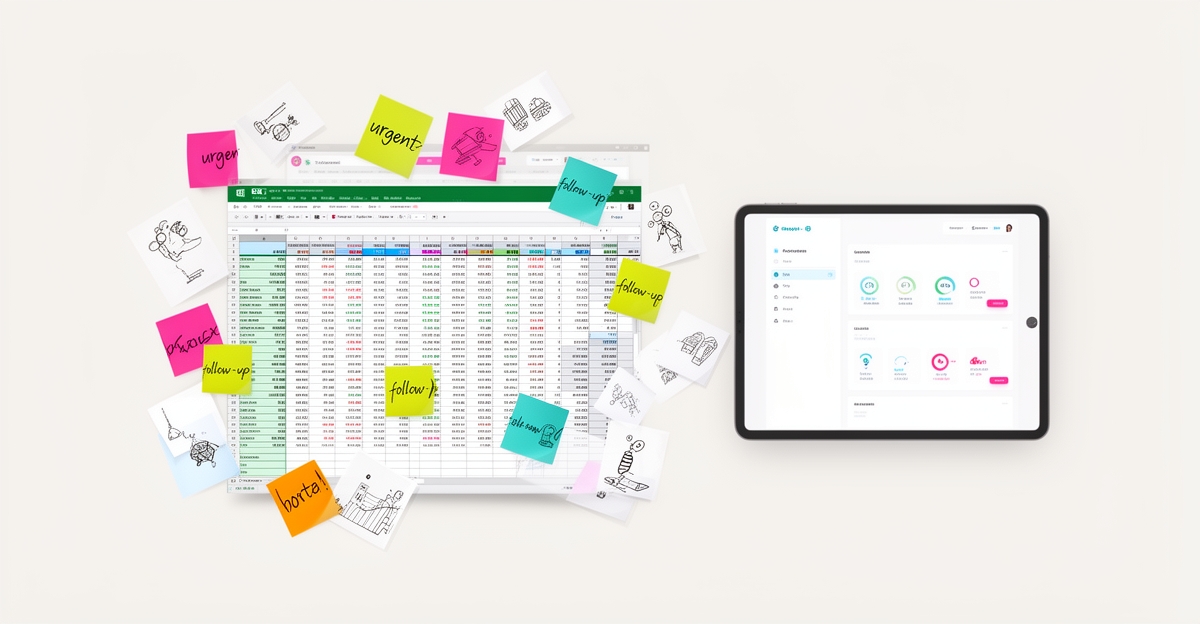
Excel feels like a quick fix for tracking customers, until the spreadsheet becomes the problem. Teams start with one sheet and end up with scattered tabs, duplicate rows, and no clear owner for follow-up.
Research consistently frames spreadsheets as a problem state for CRM. Gain.io lists pain points including leads scattered across tools, manual follow-ups always forgotten, no visibility into sales progress, and team communication lost in emails. That scattered reality is why businesses look for a single source of truth instead of a workbook.
Manual data entry creates error risk and slows the sales cycle. Nutshell CRM notes that teams save time by eliminating manual logging, with reported time savings of 2-30 hours per month depending on tier, 14.9% faster close times, and 13.4% increase in leads won. Softr reports over 1 million teams globally use their platform, with users reporting a 70% reduction in administrative workload when moving off spreadsheet-first workflows.
Collaboration breaks down quickly in Excel. There is no built-in role-based access, audit trail, or real-time collaboration designed for sales teams. Softr highlights SOC 2 Type II compliance and data hosting that supports GDPR requirements, a security and control layer Excel does not provide natively. Without those controls, version conflicts and unauthorized edits become normal.
Automation is the biggest gap. Excel cannot natively trigger lead capture, reminders, or follow-ups. The result is the exact pattern vendors describe:
- Leads sit in different sheets and get forgotten after the first touch
- Follow-ups rely on memory or manual calendar entries, so opportunities stall
- No centralized dashboard, so managers lack visibility into pipeline progress
- Data silos grow as teams email files back and forth instead of working from one record
Market messaging reflects this shift. Festi.io positions itself as an alternative to chaotic spreadsheets, claiming 70% faster development, 60% shorter time to market, 20% lower operational costs, and 30% more leads generated when moving away from scattered tools. Freshworks similarly frames Excel-like tools as inadequate for scaling due to limitations in automation, real-time collaboration, and AI-driven insights.
For businesses evaluating a custom CRM approach, the hidden cost is not the spreadsheet license. It is the lost revenue from missed follow-ups and invisible pipeline. AI Business Sites works with service businesses that need a website that functions as a system, not a brochure, and that includes a built-in CRM with lead capture, automated follow-up, and a visual pipeline so nothing falls through the cracks.
A purpose-built system replaces repetitive data entry with automation and gives owners a single dashboard for contacts, deals, notes, and tasks. That is the difference between tracking customers in Excel and actually running a CRM.
Why Dedicated CRMs Outperform Spreadsheets
While Excel offers a familiar interface for tracking contacts and notes, relying on it as a CRM creates significant operational drag that dedicated systems eliminate. Manual data entry, version control chaos, and the absence of built-in automation mean teams waste hours each week on tasks a purpose-built CRM handles automatically—like logging calls, triggering follow-ups, or updating deal stages. This isn’t just inconvenient; it directly impacts revenue by letting leads slip through the cracks due to forgotten tasks or scattered information across multiple spreadsheet tabs.
Dedicated CRM platforms deliver measurable efficiency gains by centralizing data and automating repetitive work. For example, Nutshell CRM users report saving 2–30 hours per month depending on their subscription tier, alongside a 13.4% increase in leads won and 14.9% faster deal closure times—all stemming from reduced manual logging and better pipeline visibility. Similarly, Runo’s AI-powered call analytics achieve a 78% connect rate, which is 2.3 times higher than traditional telephony systems under 30%, demonstrating how intelligent automation directly improves sales outcomes. These advantages compound when combined with features like real-time collaboration and role-based access, which prevent the data silos and conflicting versions that plague Excel-based tracking.
Beyond time savings, purpose-built systems address core limitations Excel simply cannot overcome. Platforms like Softr enable teams to create custom CRM applications that integrate with spreadsheet data while adding critical functionality such as automated workflows, role-based permissions, and audit trails—features Excel lacks entirely. This hybrid approach acknowledges Excel’s utility as a data source while leveraging dedicated tools for security, scalability, and AI-driven insights like sentiment analysis or predictive lead scoring. For businesses aiming to scale beyond basic contact management, the hidden costs of manual effort, errors, and missed opportunities in Excel far outweigh the subscription cost of a CRM designed to automate the sales process from lead capture to closed deal. AI Business Sites includes such a CRM within its managed platform, eliminating the need to build or maintain these systems independently.
Local business: doing this the old way?
One system replaces the whole pile.
All of it — the website, the follow-up, the content, the leads — built and run for you for $1,497 + $497/mo. Month-to-month, and you own everything.
See what your build includesA Smarter Path: AI-Powered CRM Without the Complexity
A Smarter Path: AI-Powered CRM Without the Complexity
Trying to build a CRM in Excel might seem like a cost-effective shortcut, but the research shows it creates more problems than it solves. Excel lacks automation, real-time collaboration, and AI-powered features, leading to scattered leads, forgotten follow-ups, and limited visibility into sales progress. As one industry report notes, businesses using spreadsheets force teams into manual processes that are error-prone and difficult to scale. Gain.io highlights how leads get scattered across tools and follow-ups are consistently forgotten when relying on spreadsheets, while Freshworks confirms these systems fail to deliver the centralized data management modern sales teams need.
Instead of wrestling with formulas and version control, AI Business Sites offers a done-for-you CRM that eliminates Excel’s flaws entirely. For $497/month, you get a fully managed system with AI lead capture, automated follow-ups, and a one-screen dashboard—no setup, no technical overhead, and no per-seat fees. The platform includes AI-powered quote generation from calls, instant job creation upon approval, and automated review requests after payment, closing the field-service loop without add-ons. Unlike Excel, it provides role-based access, audit trails, and GDPR-compliant data hosting, addressing the security and collaboration gaps that make spreadsheets risky for growing businesses. Softr.io reports users see a 70% reduction in administrative workload when switching from spreadsheet-based systems to platforms with built-in automation and role-based controls—exactly what AI Business Sites delivers as part of its managed service.
The real advantage isn’t just functionality—it’s ownership and simplicity. You own the code, content, lead data, and domain, with the ability to export everything if you ever leave. There’s no need to learn prompting, manage servers, or babysit integrations; our team handles maintenance, monitoring, and continuous improvement while you focus on running your business. As the research confirms, free tools like Excel only save money if your time has no value—AI Business Sites replaces the technical project with a working system that starts delivering leads from day one. Festi.io notes businesses using AI-powered alternatives see 30% more leads generated and 20% lower operational costs, outcomes built into our $497/month offer without hidden fees or complexity.
Frequently Asked Questions
Can I really build a functional CRM in Excel without technical skills?
What are the hidden costs of using Excel as a CRM instead of a dedicated system?
Is it true that Excel can’t support real-time team collaboration for CRM?
Can automation really save that much time if I switch from Excel to a CRM?
Aren’t free tools like Excel good enough if I’m on a tight budget?
What if I already have data in Excel—can I still use a CRM without losing it?
From Spreadsheets to Systems: Your Next Step Forward
The evidence is clear: while Excel might feel like a convenient starting point for tracking customers, its limitations in automation, collaboration, and scalability quickly turn it into a liability. Manual data entry, scattered leads, and forgotten follow-ups don’t just waste time—they directly impact revenue by letting opportunities slip through the cracks. Dedicated CRM platforms solve these problems by centralizing data, automating repetitive tasks, and providing real-time visibility into your sales pipeline. For service businesses looking to move beyond spreadsheets, the smarter path isn’t building a CRM in Excel—it’s adopting a system designed to run your business behind the scenes. If you’re ready to replace spreadsheet chaos with a working CRM that captures leads, automates follow-ups, and gives you a single dashboard for contacts and deals, the next step is simple. Book a free strategy call to see how AI Business Sites can build and manage your AI-powered website and CRM—so you can focus on running your business, not maintaining your tools.
FOR local businesss — BUILT AND RUN BY US
Your website. Your content. Your leads. Your data.
$500 starts your build. Seven days later it's live — chat, booking, follow-up, and your Google presence all set up. Then we run it, every month. You do the work you actually get paid for.